Destination: Lobuche Village, Khumbu, Solukhumbu
Region: Everest / Khumbu Region
Lobuche Elevation: Approximately 4,940 m
Trek Grade: Moderate to challenging
Typical Duration: About 10 to 12 trekking days from Kathmandu, depending on transport and itinerary
Starting Point: Kathmandu
Trek Starting Point: Lukla
Highest Overnight Stop: Lobuche, around 4,940 m
Accommodation: Tea houses/lodges
Best Seasons: Spring and autumn
Required Permits: Sagarmatha National Park entry permit and TIMS, subject to current regulations
Guide: Required under current Nepal Tourism Board rules for Everest-region trekking routes
Main Route: Kathmandu -> Lukla -> Phakding -> Namche -> Tengboche -> Dingboche -> Thukla -> Lobuche
Main Purpose: Reach and experience Lobuche village without continuing to Everest Base Camp or climbing Lobuche Peak
Important: This article is specifically about Lobuche Village, not Lobuche East or Lobuche West Peak climbing. Lobuche village is a high-altitude settlement on the standard Everest Base Camp route. Lobuche East is a 6,119 m climbing peak and requires a completely different level of preparation and equipment.
Introduction to Kathmandu to Lobuche Village Trek
The Kathmandu to Lobuche Village Trek is a high-altitude journey into Nepal's Khumbu region that takes trekkers deep into the Everest landscape without requiring them to complete the entire Everest Base Camp route.
Lobuche is a small settlement at approximately 4,940 meters above sea level, situated along the trail between Thukla and Gorak Shep. It lies inside Sagarmatha National Park and is one of the final overnight settlements before Everest Base Camp.
For many trekkers, Lobuche is not the final destination but an important overnight stop on the way to Everest Base Camp.
However, it can also be treated as the endpoint of a shorter itinerary for travelers whose primary interest is experiencing the high-altitude Khumbu landscape, walking beside the Khumbu Glacier, seeing the Everest-region mountains and reaching a settlement close to the world's highest mountain without undertaking the additional walk to Gorak Shep and Everest Base Camp.
That distinction is important when planning this trek. A trek to Lobuche village is still a serious high-altitude trek. Reaching 4,940 meters means altitude, cold, weather and acclimatization must be taken seriously even though you are not climbing a mountain.
Where Is Lobuche Village?
Lobuche is a small high-altitude settlement in Solukhumbu District of eastern Nepal, within the Khumbu region and Sagarmatha National Park.
The settlement sits beside the trail leading toward Everest Base Camp. Coming from the lower Khumbu, trekkers normally reach Lobuche after passing through Dingboche, Thukla and the Thukla Pass/memorial area. From Lobuche, the trail continues toward Gorak Shep and Everest Base Camp.
At roughly 4,940 m, Lobuche is dramatically different from the villages encountered earlier in the trek. The lower parts of the Everest route contain forests, rivers, bridges and larger Sherpa settlements.
By the time you reach Lobuche, vegetation is sparse, the landscape is dominated by rock and glacial terrain, and the air is considerably thinner.
It is also important not to imagine Lobuche as a large traditional village such as Namche Bazaar. Modern descriptions of the settlement more accurately portray it as a small cluster of trekking lodges serving trekkers and climbers.
Lobuche Village vs Lobuche Peak: Do Not Confuse Them
The name "Lobuche" can cause considerable confusion when researching Everest-region trekking.
Lobuche Village is a settlement at approximately 4,940 m. It is reached by ordinary trekking and is part of the standard route toward Everest Base Camp.
Lobuche East is a mountain summit rising to approximately 6,119 m. Reaching its summit involves mountaineering rather than ordinary trekking and requires specialized equipment, technical skills and a climbing itinerary.
Lobuche West is another distinct peak and is more technical still.
Therefore, if your objective is simply to walk to Lobuche Village, you do not need crampons, an ice axe, climbing ropes or mountaineering training for a summit attempt. Those requirements belong to a Lobuche Peak climbing expedition, not a trek to the village.
Why Trek to Lobuche Village?
The most obvious reason to trek to Lobuche is its location. It takes you deep into the Everest region and is considerably higher than most popular short treks in Nepal.
But the attraction is not simply altitude.
The journey gives you the gradual transition from the green hills around Lukla into the alpine environment of the upper Khumbu. Along the way, you pass through Sherpa settlements, Buddhist monasteries, high mountain valleys, and increasingly rugged terrain before reaching Lobuche.
The final approach is particularly memorable. After leaving Dingboche, the trail continues toward Thukla before climbing toward the memorial area dedicated to climbers and Sherpas who lost their lives in the Himalayas.
Beyond this section, the landscape becomes increasingly barren as the trail approaches Lobuche and the Khumbu Glacier.
Lobuche also provides a very different perspective from the popular viewpoints and lower villages. You are no longer simply looking at the Himalayas from a distant green valley; you are surrounded by the high-altitude landscape that forms the approach to Everest.
What Can You See on the Kathmandu to Lobuche Trek?
The scenery changes substantially throughout the journey.
From Kathmandu, the trip begins in Nepal's urban environment. After flying to Lukla, the landscape immediately becomes mountainous, with trails following the Dudh Koshi River and passing through forests and villages.
As you approach Namche Bazaar, the terrain becomes more dramatic. Beyond Namche, the trail passes through the upper Khumbu and eventually follows the Imja Khola toward Tengboche, Pangboche and Dingboche.
Nepal Tourism Board identifies this section as a route with views of peaks including Thamserku, Kangtega, Ama Dablam, Lhotse and Everest.
The landscape becomes progressively more alpine after Dingboche. Trees become scarce, the valley opens up and the mountains dominate the surroundings.
Major Sights Along The Journey
Sherpa villages and traditional settlements
Dudh Koshi River and its tributaries
Suspension bridges
Tengboche Monastery
Ama Dablam
Lhotse
Everest
Thukla/Dughla
Everest memorials
Khumbu Glacier
Lobuche Peak
Nuptse and surrounding Himalayan peaks
The scenery is one of the main reasons not to rush this trek. The route is itself the experience.
Kathmandu to Lobuche Village Trek Route
A realistic route follows the established Everest trekking corridor:
Kathmandu -> Lukla -> Phakding -> Namche Bazaar -> Tengboche -> Dingboche -> Thukla -> Lobuche
This is not a direct Kathmandu-to-Lobuche journey. Kathmandu is the logistical starting point, while Lukla is the practical trekking trailhead for the standard route.
The walking begins around Lukla and gradually gains elevation through the Khumbu Valley. The itinerary must include adequate acclimatization because the final sections reach nearly 5,000 meters.
Section | Approx. Elevation |
Kathmandu | 1,400 m |
Lukla | 2,860 m |
Phakding | 2,610 m |
Namche Bazaar | 3,440 m |
Tengboche | 3,860 m |
Dingboche | 4,410 m |
Thukla | ~4,620 m |
Lobuche | ~4,940 m |
How Many Days Do You Need for the Trek?
There is no responsible way to turn Kathmandu to Lobuche into a very short trek simply by increasing daily walking hours.
The reason is altitude.
A sensible itinerary needs enough time to move gradually from Lukla to nearly 5,000 meters and should include acclimatization in the Khumbu. The conventional Everest route normally includes an acclimatization stop at Namche Bazaar and another around Dingboche, before continuing toward Lobuche.
A practical Kathmandu-to-Lobuche itinerary generally takes around 10 to 12 days, depending on whether you fly to and from Lukla, how many acclimatization days you use, and whether weather affects flights.
A typical structure could look like this:
Day | Route | Overnight |
1 | Kathmandu -> Lukla -> Phakding | Phakding |
2 | Phakding -> Namche Bazaar | Namche |
3 | Acclimatization and local hike | Namche |
4 | Namche -> Tengboche | Tengboche |
5 | Tengboche -> Dingboche | Dingboche |
6 | Acclimatization in Dingboche | Dingboche |
7 | Dingboche -> Thukla -> Lobuche | Lobuche |
8 | Explore Lobuche / optional high-altitude walk | Lobuche |
9 | Lobuche -> Pangboche or Tengboche | Lower Khumbu |
10 | Trek to Namche | Namche |
11 | Namche -> Lukla | Lukla |
12 | Lukla -> Kathmandu | Kathmandu |
This is an example rather than a fixed itinerary. The number of nights at each location should be adjusted according to the trekker's acclimatization, weather and transportation conditions.
Kathmandu to Lobuche Village Trek Itinerary
Day 1: Kathmandu to Lukla and Trek to Phakding
The journey normally begins with a flight from Kathmandu to Lukla, the principal gateway for the classic Everest trekking route.
After landing, you begin walking through the lower Khumbu. The trail initially passes through villages, forests and river valleys before reaching Phakding.
This first walking day is intentionally shorter than the later high-altitude stages. It allows trekkers to begin adapting to the environment rather than immediately attempting a long ascent.
Overnight: Phakding
Day 2: Phakding to Namche Bazaar
The trail continues north through the Dudh Koshi Valley toward Namche Bazaar.
This section introduces trekkers to the characteristic terrain of the Everest region, including suspension bridges, forested paths and progressively steeper climbs.
Namche Bazaar sits at approximately 3,440 m and is one of the most important settlements in the Khumbu. It is also a critical acclimatization location rather than simply another overnight stop.
Overnight: Namche Bazaar
Day 3: Acclimatization at Namche Bazaar
Do not treat the acclimatization day as a wasted day.
At this elevation, your body needs time to adjust before the route climbs substantially higher. The day can include a relatively short hike around Namche and nearby viewpoints before returning to the same accommodation for the night.
The principle is simple: climb higher during the day and sleep lower than your highest daytime elevation when appropriate, rather than continuously sleeping at progressively higher elevations without allowing your body to adjust.
The Nepal Tourism Board also identifies Namche as an important stop on the Everest route, with nearby Sherpa villages and viewpoints accessible from the town.
Overnight: Namche Bazaar
Day 4: Namche Bazaar to Tengboche
Leaving Namche, the trail continues toward Tengboche.
This is one of the most scenic sections of the trek. The route provides views of major Himalayan peaks while moving through forests and mountain settlements.
Tengboche is particularly significant because of Tengboche Monastery, one of the best-known monasteries in the Khumbu region. The monastery's setting beneath the Himalayan peaks is one of the memorable cultural and scenic moments of the trek.
Overnight: Tengboche
Day 5: Tengboche to Dingboche
From Tengboche, the route continues through the upper Khumbu toward Dingboche.
The environment begins to change noticeably. Forest becomes less dominant and the landscape becomes more open and alpine.
Dingboche, at approximately 4,410 m, is another major acclimatization point on the Everest route.
Overnight: Dingboche
Day 6: Acclimatization at Dingboche
Dingboche is where the effects of altitude become much more noticeable.
Instead of immediately continuing toward Lobuche, a dedicated acclimatization day gives your body additional time to adjust.
You can take a gradual hike above the village and return to Dingboche for the night. The objective is not to cover a large distance but to expose the body to a higher elevation without adding unnecessary exhaustion.
This day becomes increasingly important because the next stages take you above 4,600 m and eventually to almost 5,000 m.
Overnight: Dingboche
Day 7: Dingboche to Thukla and Lobuche
This is one of the most significant days of the trek.
From Dingboche, the trail progresses toward Thukla. The route then climbs toward the memorial area where numerous stone structures commemorate climbers and Sherpa guides who died in the Himalayas.
Beyond this section, the trail continues alongside the Khumbu Glacier toward Lobuche.
The Nepal Tourism Board describes the walk from Dingboche/Pheriche to Lobuche as approximately six hours, with Lobuche situated on the lateral moraine of the Khumbu Glacier.
The final climb is not necessarily technically difficult, but the altitude makes the effort considerably harder than the distance might suggest.
Eventually, the small collection of lodges that forms Lobuche comes into view.
Overnight: Lobuche
Day 8: Exploring Lobuche Village
If your objective is specifically the Lobuche Village Trek, this is where the itinerary can differ from a standard Everest Base Camp trek.
You do not have to continue to Gorak Shep or Everest Base Camp simply because the trail does.
Instead, you can use the day to experience the high-altitude surroundings, take a short acclimatization-oriented walk if conditions permit and appreciate the landscape around the settlement.
Lobuche is already at approximately 4,940 m, so this should not be treated as an ordinary sightseeing day. Even a short walk can feel demanding at this elevation.
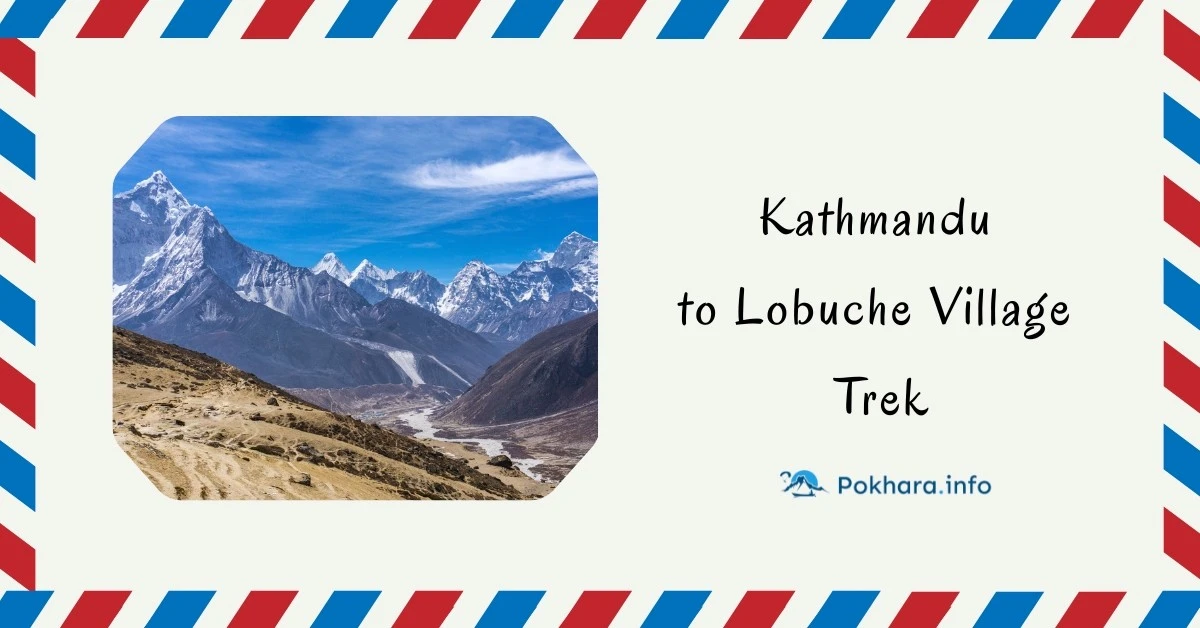
The surrounding landscape includes the Khumbu Glacier, Lobuche Peak, Nuptse and other Himalayan peaks.
Overnight: Lobuche
Day 9: Lobuche to a Lower Khumbu Settlement
After reaching the endpoint of the trek, the safest and most logical approach is to begin descending rather than attempting to remain at almost 5,000 m unnecessarily.
You can retrace the route toward Thukla and then continue toward Pheriche or another suitable lower settlement, depending on your itinerary.
Descending is generally easier on the body from an altitude perspective, although the rocky trail can still place considerable stress on the knees and legs.
Overnight: Pheriche or another planned lower settlement
Days 10 to 12: Return to Kathmandu
The return journey generally follows the same broad route back through the Khumbu.
You continue toward Namche Bazaar, then Lukla, before taking a flight back to Kathmandu.
Flight schedules in the Everest region can be affected by weather, visibility and operational conditions, so it is sensible to keep some flexibility in your overall travel schedule.
Is Lobuche Village Trek Difficult?
The trek should not be described as an easy trek.
The trail itself does not require technical climbing skills, but altitude changes the difficulty significantly. Reaching approximately 4,940 m means that a route that might appear moderate on a map can feel physically demanding.
The major challenges are:
Long uphill sections
Repeated ascents and descents
High altitude
Reduced oxygen availability
Cold temperatures
Rocky and uneven terrain
Possible snow and ice in winter
Weather changes
Flight delays affecting the itinerary
Fatigue during the final approach to Lobuche
The most important distinction is between technical difficulty and altitude difficulty.
You do not need to climb a technical mountain to reach Lobuche village. However, you do need to be capable of walking for several hours at elevations approaching 5,000 meters.
Do You Need Previous Trekking Experience?
Previous high-altitude trekking experience is helpful but not mandatory for a properly planned Lobuche Village Trek.
A reasonably fit person who regularly hikes, walks or exercises can prepare for the physical demands. However, physical fitness does not eliminate altitude risk.
Someone who can comfortably run or hike at low elevation can still experience altitude-related problems.
Preparation should therefore involve both:
Physical conditioning for long uphill and downhill walks.
Proper acclimatization to allow the body to adapt to increasing elevation.
Do not judge your readiness solely by how easily you handle exercise at home.
Altitude on the Kathmandu to Lobuche Trek
Altitude is arguably the most important issue to understand before booking this trek.
The elevation rises from around 1,400 m in Kathmandu to approximately 2,860 m at Lukla, then to 3,440 m at Namche, 4,410 m at Dingboche and nearly 4,940 m at Lobuche.
That is a substantial change in elevation over a relatively short period.
Symptoms That Should Not Be Ignored
Altitude sickness can present with symptoms such as:
Headache
Nausea
Dizziness
Unusual tiredness
Loss of appetite
Difficulty sleeping
Shortness of breath
Mild symptoms should be communicated to your guide and monitored carefully. Worsening or severe symptoms require immediate attention and descent rather than continuing upward.
Do not attempt to "push through" serious altitude symptoms simply because Lobuche is close.
Planning & Preparation for Lobuche Village Trek
Here’s everything you need to plan & prepare for Lobuche Village Trek
Permits for the Lobuche Village Trek
Because Lobuche lies inside the Everest trekking region and Sagarmatha National Park, permits and trekking registration requirements apply.
The Sagarmatha National Park entry permit is required for entry into the protected area.
In addition, current Nepal Tourism Board rules require trekkers on listed Everest-region routes to be accompanied by a licensed trekking guide and carry a TIMS card issued through a trekking agency. The Nepal Tourism Board's current list specifically includes Everest Base Camp, Gokyo, Cho La, Three Passes and Everest View routes.
Because the exact administrative classification of an itinerary can depend on the route arranged by your agency, permits should be confirmed with the agency before departure rather than relying on old blog posts that list outdated requirements.
Is a Guide Mandatory?
Under the current Nepal Tourism Board TIMS provisions, listed Everest-region trekking routes require trekkers to be accompanied by a licensed trekking guide and to carry an agency-issued TIMS card.
This is particularly relevant for a Lobuche itinerary because it takes you into a high-altitude environment where weather, navigation and altitude-related emergencies can become serious concerns.
A guide is not simply someone who shows you the trail. A good guide can help monitor your condition, adjust the pace, communicate with lodges and assist if weather or other problems disrupt the itinerary.
Accommodation in Lobuche
Accommodation in Lobuche is primarily based around tea houses and trekking lodges.
Do not expect hotel-style facilities at nearly 5,000 meters.
Rooms are generally basic, and shared facilities are common. Conditions become particularly cold at night because of the elevation and exposed environment.
The dining area is often the social center of a high-altitude lodge. Trekkers from different countries and different itineraries gather there to eat, warm themselves and discuss the trail ahead.
The basic nature of accommodation is not a flaw in the trek; it is simply a consequence of operating lodges in such a remote and high-altitude environment.
Food and Drinking Water
Tea houses along the route generally provide meals designed around the needs of trekkers.
Common choices include:
Dal bhat
Rice and vegetable dishes
Noodles
Pasta
Soups
Potatoes
Eggs
Momos
Bread and pancakes
Tea and other hot drinks
At higher elevations, appetite can decrease, but you still need sufficient calories to support several hours of walking.
Hydration is equally important. Carry a reusable bottle or hydration system and use treated or purified water from reliable sources. Avoid assuming that clear mountain water is automatically safe to drink.
Best Time for the Kathmandu to Lobuche Village Trek
The most favorable trekking periods are generally spring and autumn.
Spring: March to May
Spring brings relatively favorable trekking conditions, increasing temperatures and rhododendron blooms at lower elevations. Visibility can also be excellent on clear days.
Autumn: September to November
Autumn is traditionally one of Nepal's strongest trekking seasons. After the monsoon, visibility is often good and the weather is generally more stable.
Winter: December to February
Winter can provide clear mountain views, but temperatures become considerably colder and snow can affect higher sections of the route. Conditions around Lobuche can be severe, and accommodation and trail conditions need to be checked before departure.
Monsoon: June to August
Monsoon is generally less suitable for this trek because lower sections can experience heavy rainfall, wet trails and reduced mountain visibility. Flights to Lukla can also be affected by poor weather.
For a first-time trekker, spring and autumn are generally the easiest seasons in which to plan the journey, while winter requires greater preparation for cold and snow.
What Should You Pack?
Packing for Lobuche requires more than packing for a low-altitude Nepal hike.
Clothing
Carry a layering system rather than relying on one extremely thick jacket:
Moisture-wicking base layers
Fleece or insulating mid-layer
Down or insulated jacket
Waterproof/windproof outer shell
Trekking trousers
Thermal layers
Warm hat
Gloves
Sun hat
Several pairs of trekking socks
Footwear
Good trekking boots with adequate grip are essential. Break them in before the trek rather than wearing brand-new boots for the first time in the Khumbu.
Essential equipment
Sleeping bag suitable for cold conditions
Headlamp
Trekking poles
Sunglasses
Sunscreen
Water bottles
Water purification method
Personal first-aid supplies
Personal medication
Power bank
Basic toiletries
Small daypack
Waterproof bags for electronics and important documents
You do not need technical climbing equipment simply to trek to Lobuche Village. Crampons, ice axes and climbing equipment are associated with technical peak climbing, including Lobuche East, rather than ordinary trekking to the settlement.
What Is the Cost of the Kathmandu to Lobuche Trek?
There is no single legitimate price for this trek because the final cost depends heavily on what is included.
Your budget can include:
Kathmandu accommodation
Lukla flights
Trekking permits
TIMS
Guide
Porter
Tea-house accommodation
Meals
Local transportation
Travel insurance
Equipment rental
Emergency expenses
Personal spending
The biggest cost differences usually come from transportation, guide and porter arrangements, accommodation standards and whether your package includes meals and Kathmandu hotels.
Rather than choosing a trek based only on the lowest advertised price, check exactly what the package includes.
A responsible package should clearly state whether permits, flights, accommodation, meals, guide, porter and airport transfers are included.
Travel Insurance and Emergency Planning
Travel insurance is strongly recommended for a high-altitude trek like this.
Before purchasing a policy, check the actual altitude limit and whether the policy covers trekking at approximately 5,000 meters.
Also check whether it covers:
Emergency medical treatment
Helicopter evacuation
High-altitude trekking
Trip interruption
Flight delays or cancellations, where applicable
Do not assume that ordinary travel insurance automatically covers high-altitude trekking or helicopter rescue.
Kathmandu to Lobuche Village Trek vs Everest Base Camp Trek
These two trips share most of their route but have different objectives.
Feature | Lobuche Village Trek | Everest Base Camp Trek |
Main destination | Lobuche | Everest Base Camp |
Lobuche included | Yes | Yes |
Gorak Shep | Usually not required | Yes |
Everest Base Camp | No | Yes |
Maximum altitude | ~4,940 m | ~5,364 m at EBC; higher if Kala Patthar is included |
Duration | Shorter | Longer |
High-altitude exposure | Significant | Greater |
Technical climbing | No | No |
Suitable for | Trekkers wanting the upper Khumbu/Lobuche experience without EBC | Trekkers specifically wanting to reach EBC |
The important point is that Lobuche Village Trek is not an alternative name for Everest Base Camp Trek. Lobuche is one of the final settlements on the standard EBC route. The Nepal Tourism Board describes the route from Lobuche onward to Gorak Shep and then Everest Base Camp.
Can You Continue to Everest Base Camp from Lobuche?
Yes.
Lobuche is normally followed by Gorak Shep, from where trekkers continue to Everest Base Camp. The walk from Lobuche to Gorak Shep is roughly three hours according to the Nepal Tourism Board, although actual time depends on conditions and the trekker's pace.
So a trekker who reaches Lobuche and later decides to continue can incorporate the final section into a longer Everest Base Camp itinerary, provided the itinerary, acclimatization, and physical condition are appropriate.
However, this should not be treated as a casual extra day. At these elevations, even relatively short distances can be physically demanding.
Responsible Trekking in the Khumbu
The Everest region receives visitors from around the world, but it remains a fragile high-mountain environment.
Trekkers should:
Carry reusable water bottles.
Minimize single-use plastic.
Use designated waste facilities.
Avoid damaging vegetation.
Stay on established trails.
Respect monasteries and religious sites.
Ask permission before photographing local people.
Avoid unnecessary noise in villages.
Support locally owned lodges and businesses where possible.
Responsible travel is particularly important in a region where tourism is one of the major sources of livelihood.
Practical Tips Before You Leave Kathmandu
A successful Lobuche trek is largely about preparation rather than speed.
Do not underestimate the altitude. The biggest mistake is assuming that because Lobuche is a village rather than a mountain summit, reaching it is easy.
Build acclimatization into the itinerary. Namche and Dingboche are not merely overnight stops; they are important stages in adapting to elevation.
Keep your schedule flexible. Lukla flights can be affected by weather, so avoid scheduling an international flight immediately after your expected Lukla return.
Walk slowly. A consistent pace is more useful at altitude than trying to finish quickly.
Tell your guide if you feel unwell. Do not hide symptoms because you are worried about changing the itinerary.
Prepare for cold nights. Lobuche is nearly 5,000 meters above sea level, and its accommodation is basic.
Carry enough personal essentials. Services become increasingly limited as you move deeper into the Khumbu.
Who Is the Kathmandu to Lobuche Village Trek For?
This trek is best suited to travelers who want to experience the upper Everest region without necessarily committing to Everest Base Camp.
It can be particularly appealing if you:
Want to experience the Khumbu at high altitude.
Want to see Everest-region mountains.
Are interested in Sherpa culture.
Want to walk through the Sagarmatha National Park.
Have enough time for proper acclimatization.
Prefer a shorter objective than Everest Base Camp.
Do not intend to climb Lobuche Peak.
It is not an appropriate choice simply because you think it is an "easy version" of Everest Base Camp. The altitude remains a major challenge.
Conclusion
The Kathmandu to Lobuche Village Trek is best understood as a high-altitude journey into the upper Khumbu rather than simply a shorter Everest Base Camp walk.
The route takes you from Kathmandu to Lukla and gradually through the Sherpa settlements of the Everest region, with important acclimatization stops at Namche Bazaar and Dingboche. By the time you reach Lobuche, the green valleys have given way to a stark alpine landscape dominated by rock, glaciers and enormous Himalayan peaks.
Lobuche itself is small, cold and basic, but its significance comes from its location. It stands on one of the world's most famous trekking routes and provides a genuine experience of the high-altitude Everest landscape without requiring trekkers to climb Lobuche Peak or necessarily continue all the way to Everest Base Camp.
The key to completing the trek successfully is not speed but acclimatization, preparation and flexibility. At nearly 5,000 meters, the altitude deserves more respect than the distance on a map might suggest.
And most importantly, when planning the trip, make sure the itinerary says Lobuche Village Trek if your intention is to reach the settlement. Lobuche Peak climbing is a completely different adventure.
Frequently Asked Questions
How high is Lobuche Village?
Lobuche sits at approximately 4,940 meters (16,200 feet) above sea level. It is one of the highest settlements used as an overnight stop on the Everest Base Camp route.
Is Lobuche a real village?
Yes, but it is a very small high-altitude settlement. It is more accurately described as a cluster of trekking lodges serving trekkers and climbers than a large traditional village with extensive permanent infrastructure.
Is Lobuche Village the same as Lobuche Peak?
No. Lobuche Village is a settlement at approximately 4,940 m. Lobuche East is a 6,119 m climbing peak. A normal trek to Lobuche Village does not require technical mountaineering equipment.
Is Kathmandu to Lobuche a direct trek?
No. You travel from Kathmandu to the Everest region first, normally using a flight to Lukla, and then begin trekking through the Khumbu Valley. The standard route passes through places such as Phakding, Namche Bazaar, Tengboche and Dingboche before reaching Lobuche.
How long does it take to trek from Kathmandu to Lobuche?
A realistic itinerary generally takes around 10 to 12 days, including transportation and necessary acclimatization. The exact duration depends on the flight schedule, acclimatization plan and return arrangements.
Do I need a guide for the Lobuche Trek?
Current Nepal Tourism Board rules require a licensed guide and agency-issued TIMS for listed Everest-region trekking routes, including Everest Base Camp and other major routes in the region.
Do I need a permit for Lobuche?
Yes. The route enters Sagarmatha National Park, so the relevant national park entry permit is required. Current TIMS requirements also apply to covered Everest-region trekking routes. Confirm the exact permit package with your licensed trekking agency before departure.
Can beginners do the Lobuche Village Trek?
A beginner with good fitness can potentially complete the trek with a properly designed itinerary, guide and acclimatization schedule. However, this is not a beginner-level hike in terms of altitude. Reaching nearly 5,000 m requires serious preparation.
Is Lobuche Village Trek harder than Everest Base Camp Trek?
It depends on the itinerary. Reaching Lobuche means reaching approximately 4,940 m, while Everest Base Camp itself is around 5,364 m and Kala Patthar is higher still on itineraries that include it. Therefore, an itinerary ending at Lobuche avoids some of the highest sections of the standard EBC trek, but it remains a demanding high-altitude trek.
Can I see Mount Everest from Lobuche?
The upper Khumbu provides views of Everest and surrounding Himalayan peaks, although the exact visibility and angle depend on the location, weather and direction of view. Lobuche is surrounded by an impressive high-mountain landscape that includes Everest-region peaks.
Can I go to Everest Base Camp after reaching Lobuche?
Yes. Lobuche is on the standard route to Everest Base Camp. From Lobuche, the trail continues toward Gorak Shep and then Everest Base Camp.
Are there tea houses in Lobuche?
Yes. Lobuche has trekking lodges and tea houses, although facilities are basic compared with lower settlements. Shared bathrooms and limited hot-water facilities are common, and nights can be very cold.
What is the best season for the Lobuche Village Trek?
Spring (March to May) and autumn (September to November) are generally the preferred seasons because of more favorable trekking conditions and better mountain visibility. Winter is significantly colder, while monsoon brings rain and poorer visibility to lower sections.