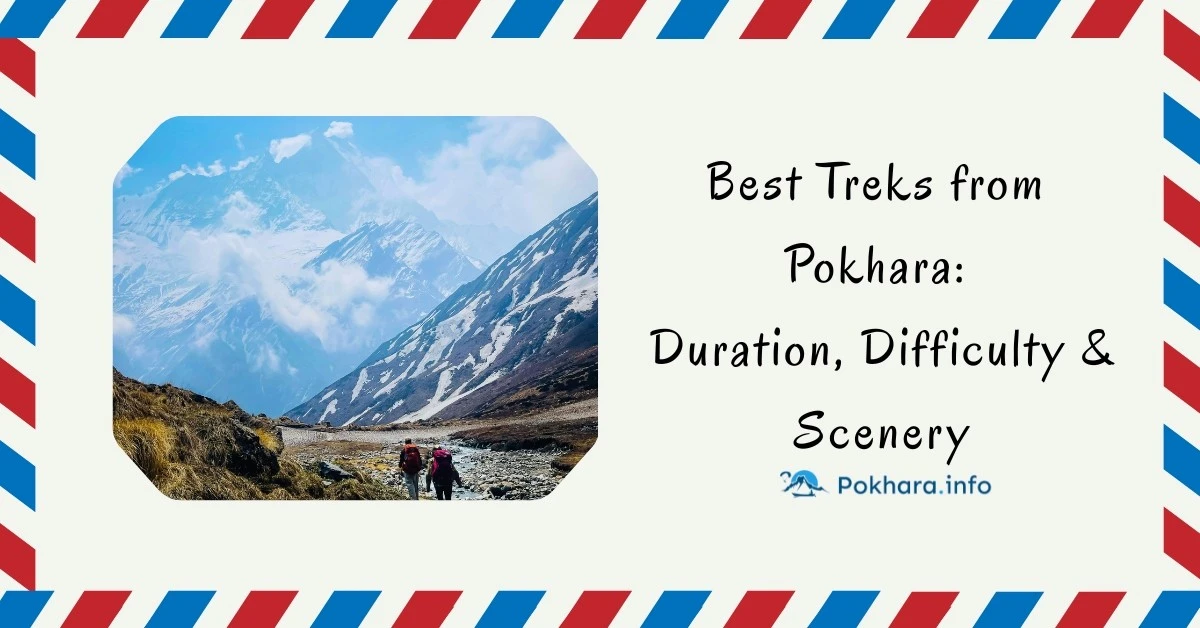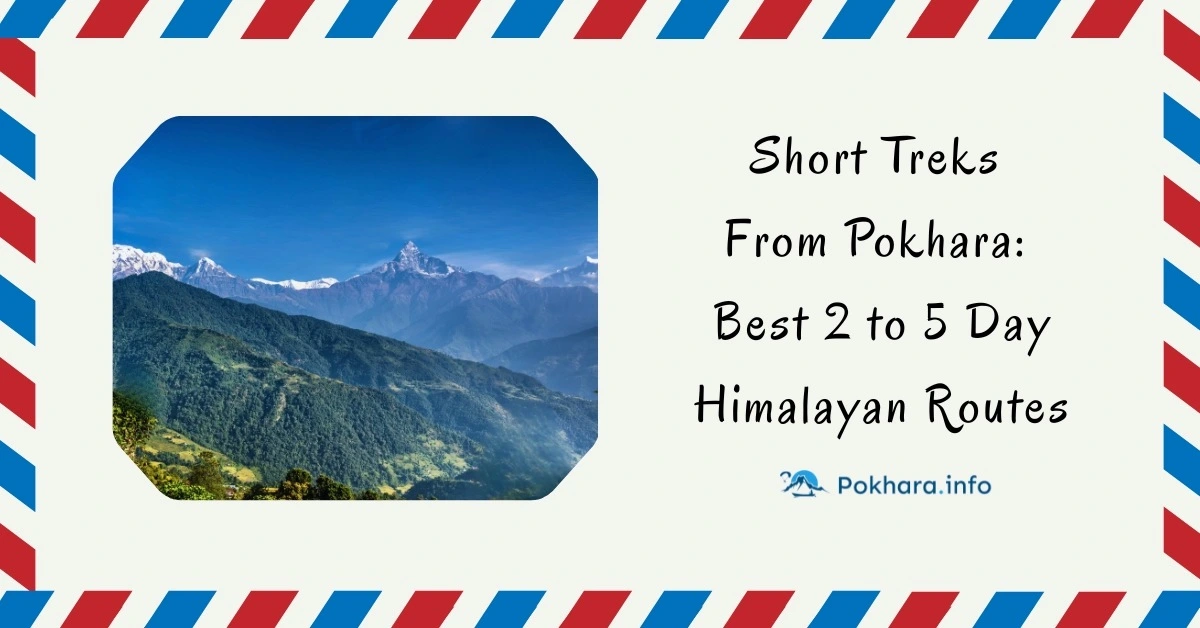
Pokhara is one of Nepal's most convenient bases for short Himalayan trekking.
Several trails in the Annapurna region can be reached by road from the city, allowing travelers to experience mountain villages, forest trails, and views of peaks such as Machhapuchhre, Annapurna South, and Dhaulagiri without committing to a week or more on the trail.
The best short treks from Pokhara range from a one-night ridge walk at relatively low altitude to five-day routes that climb above 4,000 meters. That difference matters. A two-day trek to Australian Camp is a very different experience from a five-day Mardi Himal trek, even though both can be started after a short transfer from Pokhara.
For travelers with limited time, the right route depends mainly on walking time, maximum altitude, physical difficulty, road access, and the type of scenery you want.
The routes below cover practical 2, 3, 4 and 5 days options around Pokhara.
Best Short Treks From Pokhara At A Glance
Trek | Typical Duration | Highest Point | Difficulty | Best For |
Australian Camp-Dhampus | 2 days | ~2,060 m | Easy | First-time trekkers and short weekends |
Panchase Trek | 2 to 4 days | ~2,513 m | Easy to Moderate | Forest, villages and quieter trails |
Ghandruk Trek | 2 to 3 days | ~2,000 m | Easy to Moderate | Gurung culture and mountain views |
Ghorepani-Poon Hill | 3 to 4 days | 3,210 m | Moderate | Sunrise and classic Annapurna scenery |
Mardi Himal Trek | 4 to 5 days | ~4,500 m* | Moderate to Demanding | High mountain scenery and ridge walking |
*The approximately 4,500 m figure refers to Mardi Himal Base Camp. Many five-day itineraries use the Upper View Point at around 4,200 m as their practical high point. Nepal Tourism Board identifies Mardi Himal Base Camp at 4,500 m and Poon Hill at 3,210 m.
The duration of these treks can change according to the trailhead, road conditions, walking pace, and whether transport is used to shorten or extend an itinerary.
Australian Camp And Dhampus: A 2-Day Trek From Pokhara
If you have only a weekend or want a gentle introduction to Himalayan trekking, the Australian Camp-Dhampus route is one of the shortest overnight options accessible from Pokhara.
A common itinerary begins with a drive from Pokhara to Kande, followed by an uphill walk through forest and farmland to Australian Camp. The route then continues toward Dhampus before descending to Phedi and returning to Pokhara.
Australian Camp is around 2,060 m, while Dhampus is around 1,650 m. The relatively low elevation means this route does not involve the same altitude exposure as the higher Annapurna trails.
Typical 2-day Itinerary
Day 1: Pokhara to Kande to Australian Camp
Drive from Pokhara to Kande
Walk through forest and hillside settlements
Overnight at Australian Camp
Mountain views toward Machhapuchhre and the Annapurna range
Walking time is commonly around 2 to 3 hours, depending on the exact starting point and pace.
Day 2: Australian Camp to Dhampus to Phedi to Pokhara
Early morning mountain views
Walk toward Dhampus
Descend through terraces and stone steps to Phedi
Drive back to Pokhara
The descent from Dhampus to Phedi can be more demanding on the knees than the first day's ascent.
Who Is It Suitable For?
This is a practical 2-day trek from Pokhara for travelers who want an overnight Himalayan experience without going to high altitude. It can suit first-time trekkers who are comfortable walking uphill and downhill for several hours.
Nepal Tourism Board specifically lists Australian Camp among the popular short hiking destinations around Pokhara.
Panchase Trek: A Quiet 2 to 4-Day Option
The Panchase Trek is different from the classic Annapurna routes. Rather than concentrating on a high mountain destination, it follows the forested hills west of Pokhara through villages and ridge landscapes.
Panchase reaches approximately 2,513 m and is officially listed by Nepal Tourism Board's Pokhara tourism material as a short trekking destination with itineraries of roughly 2 to 4 days. The same material describes views toward Phewa Lake and the Pokhara Valley, along with mountain views extending from Dhaulagiri toward Manaslu.
Why Choose Panchase?
Panchase works well when you want a slower rural experience rather than a high-altitude trek. The route combines:
Forest trails
Hilltop viewpoints
Traditional villages
Rural farmland
Views over Pokhara and Phewa Lake
Himalayan panoramas on clear days
The exact itinerary varies considerably because there are several ways to approach and leave the Panchase area.
Difficulty
Panchase is generally more about repeated hill climbs and descents than altitude. The maximum elevation is considerably lower than Mardi Himal or Poon Hill, but that does not make every day effortless.
A trekker still needs to be comfortable walking on uneven trails and climbing through Nepal's mid-hills. It is particularly suitable for travelers who value quiet trails, village life, and forest scenery over reaching a famous high-altitude viewpoint.
Ghandruk Trek: A 2 to 3-Day Village And Mountain Experience
Ghandruk is one of the most accessible traditional mountain villages from Pokhara and is a strong choice for travelers who want Himalayan scenery combined with Gurung culture.
Nepal Tourism Board describes Ghandruk as a traditional Gurung village with a museum and views toward Annapurna South, Gangapurna, Annapurna III, Hiunchuli, and Machhapuchhre. The tourism board also reports road access of approximately 54.8 km from Pokhara, with travel time varying according to road conditions.
Because road access reaches Ghandruk, a short Ghandruk trip does not necessarily involve several full days of walking. That makes it useful for travelers who have limited time.
A Practical Short Ghandruk Itinerary
Day 1: Pokhara to Ghandruk
Travel by road to Ghandruk and spend the afternoon exploring the village, viewpoints, and local cultural sites.
Day 2: Ghandruk to nearby villages/trails
Spend the day walking on local trails or connecting toward Landruk and surrounding settlements, depending on the chosen route.
Day 3: Return toward Pokhara
Complete the selected walking section and use road transport for the return journey.
Why Choose Ghandruk?
Ghandruk is particularly appropriate if your priority is culture and village scenery rather than maximum altitude. It also works well as a short mountain break because accommodation is available in the village.
For travelers looking for a longer walking itinerary, Ghandruk can also form part of routes toward Tadapani, Ghorepani and the Annapurna Sanctuary.
Ghorepani and Poon Hill: A 3 to 4-Day Short Trek From Pokhara
The Ghorepani-Poon Hill Trek is one of the most established short trekking routes in the Annapurna region.
Its defining feature is the climb to Poon Hill at 3,210 m, where trekkers can see a broad Himalayan panorama including the Annapurna and Dhaulagiri ranges. Nepal Tourism Board describes the Ghorepani Poon Hill Trek as a popular short trek suitable for beginners and families.
Unlike Australian Camp or Ghandruk, this route takes you significantly higher, so altitude and daily walking become more important considerations.
Typical 4-Day Itinerary
Day 1: Pokhara to Nayapul/Birethanti area to Ulleri or nearby village
A road transfer takes you toward the southern Annapurna trailhead, followed by trekking through villages and forest.
Day 2: Ulleri to Ghorepani
The trail climbs through forest and stone steps toward Ghorepani, around 2,800 m.
Day 3: Ghorepani to Poon Hill to Tadapani
An early morning climb to Poon Hill provides the main viewpoint experience. The trek then continues through rhododendron forest toward Tadapani.
Day 4: Tadapani to Ghandruk or roadhead to Pokhara
Depending on the itinerary and current road access, you can walk toward Ghandruk and use road transport for the return to Pokhara.
Some travelers compress this route into three days, while others allow four or more days for a more comfortable pace.
Difficulty
Poon Hill is not a technical trek, but it requires considerably more physical effort than Australian Camp.
The challenge comes from:
Long stair sections
Repeated uphill and downhill walking
Several hours of walking each day
Sleeping at around 2,800 m at Ghorepani
The early-morning climb to Poon Hill
Potentially cold conditions before sunrise
For someone accustomed to regular walking, it can be a manageable introduction to moderate-altitude trekking. However, it should not be treated as equivalent to a low-altitude village hike.
Mardi Himal: A 4 to 5-Day High-Altitude Trek From Pokhara
For travelers who have only five days but still want a genuine high-mountain trekking experience, Mardi Himal is one of the most direct options from Pokhara.
The trail climbs from the lower hills through forest to a high ridgeline facing Machhapuchhre (Fishtail). Nepal Tourism Board describes Mardi Himal Base Camp at approximately 4,500 m and highlights the route's close views of Machhapuchhre and the Annapurna range.
A typical five-day itinerary uses Kande as the trailhead and finishes around Siding, followed by road transport back toward Pokhara. Other itineraries use different trailheads or shorten sections with transport.
Typical 5-day Itinerary
Day 1: Pokhara to Kande to Forest Camp area
Drive to the trailhead and begin climbing through forest toward the overnight stop.
Day 2: Forest Camp to Low Camp
The trail continues upward through rhododendron and mixed forest.
Day 3: Low Camp to High Camp
The landscape becomes more open as the route climbs above the forest.
Day 4: High Camp to Upper View Point/Mardi Base Camp area to High Camp
This is the principal high-altitude day. Many itineraries use the Upper View Point at approximately 4,200 m, while routes continuing to Mardi Himal Base Camp reach approximately 4,500 m.
Day 5: High Camp to Siding to Pokhara
Descend toward Siding and continue by road to Pokhara.
Why Mardi Himal Requires More Preparation
Mardi Himal should not be grouped with easy short hikes simply because it can fit into five days.
The route involves:
Significant elevation gain
Long uphill sections
High-altitude exposure
Steeper terrain
Cold conditions at higher elevations
More basic accommodation at some higher stops
A demanding descent after reaching the high ridge
The highest sections also make acclimatization more relevant than on the lower Pokhara-area routes.
The Nepal Tourism Board currently lists Mardi Himal Trek among the Annapurna routes subject to its mandatory licensed-guide and TIMS provisions.
Which Short Trek From Pokhara Should You Choose?
The best route depends more on the experience you want than simply the number of days available.
For the shortest overnight experience: Australian Camp-Dhampus
Choose this route if you want to leave Pokhara, walk into the hills, spend one night with mountain views, and return the following day.
Its low maximum altitude and short walking sections make it substantially less demanding than the higher options.
For forests and rural landscapes: Panchase
Panchase is a better match if you prefer quieter trails, forests, villages, and views over the Pokhara Valley rather than a famous high-altitude viewpoint.
For Gurung culture: Ghandruk
Choose Ghandruk when the village experience is as important as the walking itself. Its road access also makes it possible to build a short trip around a limited amount of trekking.
For a classic Himalayan sunrise: Ghorepani-Poon Hill
Poon Hill is the natural choice when your priority is a well-established short trek culminating in a high viewpoint. At 3,210 m, however, it requires more physical preparation than the lower routes.
For the highest mountain experience within five days: Mardi Himal
Mardi Himal is the route to consider if you want high ridges and close mountain views within a compact itinerary. Its altitude and terrain make it much more demanding than the two-day routes.
How To Reach The Trekking Trailheads From Pokhara
One of the biggest advantages of trekking around Pokhara is that many trailheads are accessible by road.
For the Australian Camp-Dhampus route, travelers commonly drive toward Kande and begin walking from there. For Mardi Himal, Kande is also commonly used as an approach point, although itineraries vary.
Ghorepani itineraries generally use road transport toward the southern Annapurna trailheads before the walking begins. Ghandruk itself can be reached by road, making it possible to create a short village-based trip without walking the entire approach.
Road travel times should be treated as approximate rather than fixed. Weather, traffic, road construction and seasonal conditions can substantially affect journey times in the hills.
For a short trek, it is sensible to arrange transportation before leaving Pokhara, particularly when your return depends on a specific roadhead or shared vehicle.
Permits, TIMS And Guide Requirements
Permit requirements depend on the exact route, and this is an area where older trekking information can be misleading.
The Annapurna Conservation Area Permit (ACAP) applies to trekking routes inside the Annapurna Conservation Area. Current published information commonly lists the fee at NPR 3,000 for foreign nationals and NPR 1,000 for SAARC nationals.
Because fees and administrative procedures can change, trekkers should confirm the current rate when arranging the permit.
TIMS and guide requirements should also be checked against the specific route, rather than assuming that every short walk around Pokhara follows the same rules.
Nepal Tourism Board's current TIMS information explicitly lists Mardi Himal, Khopra Trek, Poon Hill-ABC Trek, and several other Annapurna routes among routes requiring a licensed guide and agency-issued TIMS under the current provisions.
For this reason, travelers planning a Mardi Himal trek should arrange the required guide and TIMS through a government-registered trekking agency.
For lower local hikes or routes that do not appear under the same trekking provisions, requirements can differ. Confirm the current rules for your exact itinerary before departure rather than relying on an old blog or a previous traveler's experience.
Best Time For Short Treks From Pokhara
The main trekking seasons around Pokhara are generally spring and autumn.
Spring: March to May
Spring brings warmer conditions, increasing greenery and rhododendron flowering at suitable elevations. Visibility can be good, particularly in the mornings.
Autumn: October to November
Autumn is generally one of the most reliable periods for mountain views, with clearer conditions after the monsoon. It is also one of the busiest trekking periods.
Winter: December to February
Lower routes such as Australian Camp, Dhampus, Panchase and Ghandruk can remain practical in winter, although mornings and nights can be cold. Higher routes such as Mardi Himal can experience snow and much colder conditions.
Monsoon: June to September
Rain, muddy trails, leeches, cloud, and road disruption can make trekking more difficult. Lower routes may still be possible, but mountain visibility is often less reliable and transport conditions require greater flexibility.
For any route, check the weather and local trail conditions shortly before departure.
Accommodation On Short Treks
Accommodation varies according to the route.
Australian Camp, Dhampus and Ghandruk have established lodges and guesthouses. Panchase has a more varied accommodation network, including homestay-style options depending on the itinerary.
The Ghorepani and Poon Hill route has a well-developed teahouse network.
Mardi Himal has teahouses and lodges along the main route, but facilities become simpler as elevation increases. High-altitude accommodation should not be compared with hotels in Pokhara.
For short treks during busy autumn periods, booking accommodation in advance can be useful, particularly on popular routes such as Poon Hill and Mardi Himal.
What To Pack For A 2 to 5-Day Trek
Packing should match the altitude and season rather than simply the number of days.
For most short treks, carry:
Comfortable trekking shoes with good grip
Light trekking trousers and moisture-managing layers
Warm layer or fleece
Waterproof jacket
Small backpack
Water bottle or hydration system
Sun protection, including sunglasses and sunscreen
Headlamp
Basic first-aid supplies
Personal medication
Power bank
Trekking poles if useful for steep descents
Passport and required permit documents
Some Nepalese cash
For higher routes such as Mardi Himal, add warmer clothing appropriate for temperatures at altitude.
Nepal Tourism Board also recommends carrying essentials such as a torch, rain protection and a first-aid kit when trekking.
Altitude: How The Short Treks Differ
Altitude is one of the clearest ways to distinguish these routes.
Australian Camp and Dhampus remain around 2,000 m, while Panchase reaches approximately 2,513 m. Ghandruk is around 2,000 m, depending on the specific route and village section.
Poon Hill reaches 3,210 m, making altitude a more relevant consideration. Mardi Himal is substantially higher, with the Upper View Point around 4,200 m and Mardi Himal Base Camp around 4,500 m.
This means a traveler who feels comfortable on a two-day Australian Camp trek should not automatically assume that Mardi Himal will feel similarly easy simply because both are short itineraries.
Nepal Tourism Board notes that altitude-related illness can occur above 3,000 m, making altitude awareness particularly important on higher trekking routes.
How Much Does A Short Trek From Pokhara Cost?
There is no single fixed price for a short trek because total cost depends on the route, number of trekkers, transportation, guide arrangements, accommodation, meals and permits.
A useful way to plan the budget is to divide the expense into:
Cost | What it covers |
Transportation | Jeep, taxi or bus between Pokhara and the trailhead |
Permits | ACAP and other applicable permits |
Guide | Required on routes covered by the current mandatory-guide provisions |
Accommodation | Lodge, teahouse or homestay |
Food | Meals, snacks and drinks during the trek |
Equipment | Gear rental or purchases if needed |
Insurance | Trekking and emergency-evacuation coverage |
Miscellaneous | Charging, hot showers, tips and personal expenses |
Shorter does not always mean cheaper per day. A five-day trek spreads transportation and permit costs across more days, while a two-day trek may have relatively high transport costs compared with the amount of time spent walking.
Because current prices vary by season and service level, it is better to obtain current transportation, guide, and accommodation rates in Pokhara before departure than to rely on an old fixed trekking package price.
Are Short Treks From Pokhara Suitable For Beginners?
Some are, but "short" does not automatically mean "easy."
Australian Camp-Dhampus is one of the more accessible overnight options because of its relatively low altitude and short walking stages.
Panchase and Ghandruk require more hill walking but remain relatively low compared with high-altitude routes.
Poon Hill introduces longer walking days, substantial stone steps and an overnight stay around 2,800 m.
Mardi Himal is a different category. The high-altitude ridge and steep elevation gain require better preparation, appropriate clothing and a realistic approach to acclimatization.
A beginner with limited trekking experience can therefore choose a short trek, but the route should be selected according to fitness, altitude tolerance, walking experience and the season, not just the number of days.
Planning A Short Trek From Pokhara
Before leaving Pokhara, confirm four things: your trailhead, transport, current permit requirements, and weather.
For higher routes, also check the itinerary's highest sleeping elevation and whether the planned schedule allows a sensible ascent.
Pokhara is particularly convenient because trekking agencies, equipment shops, transport providers, and tourism services are available in the city. The Nepal Tourism Board also identifies Pokhara as a base for numerous short hikes and longer Annapurna trekking routes.
If your time is limited, avoid creating an itinerary that leaves no flexibility for road delays. A two-hour difference in hill transportation can have a significant effect when you are trying to reach a trailhead and complete a fixed day's walk.
Conclusion
Short treks from Pokhara make it possible to experience the Annapurna foothills without spending one or two weeks on the trail. The key is choosing a route that matches the experience you actually want.
For a 2-day Himalayan introduction, Australian Camp and Dhampus keep the walking short and the altitude relatively low. Panchase offers a quieter mid-hill experience, while Ghandruk combines mountain scenery with Gurung village culture.
For a more traditional trekking experience, Ghorepani and Poon Hill add higher altitude and a famous sunrise viewpoint. If five days are available and you want a much higher mountain environment, Mardi Himal provides a substantially more demanding route toward the high ridge below Machhapuchhre.
The most useful way to choose is not simply to ask how many days you have.
Consider the maximum altitude, daily walking, terrain, transportation, and level of physical preparation required by each route. That approach makes it easier to find a short trek from Pokhara that fits both your schedule and your trekking experience.
Frequently Asked Questions
What is the best 2-day trek from Pokhara?
The Australian Camp-Dhampus route is one of the most practical two-day overnight treks from Pokhara. It combines a short road transfer, forest walking, a mountain-view ridge, and a stay in the Annapurna foothills.
Which is a good 3-day trek from Pokhara?
Ghandruk and Panchase can both be arranged as short three-day trips, depending on the starting point and use of road transport. Ghandruk is particularly suitable for travelers interested in Gurung village culture, while Panchase emphasizes forested hills, rural landscapes, and views around Pokhara.
What is the best 4-day trek from Pokhara?
Ghorepani-Poon Hill is a natural four-day choice for travelers who want a classic Annapurna trekking experience and a sunrise viewpoint at 3,210 m.
What is the best 5-day trek from Pokhara?
Mardi Himal is a strong five-day option for travelers seeking higher-altitude Himalayan scenery. The route can reach approximately 4,200 m at the Upper View Point and around 4,500 m at Mardi Himal Base Camp, depending on the itinerary.
Which short trek from Pokhara is suitable for beginners?
Australian Camp-Dhampus is generally the most accessible option among the routes discussed here because it stays at relatively low altitude and has short walking stages. Poon Hill and Mardi Himal require progressively more physical preparation and altitude awareness.
Do I need a guide for short treks from Pokhara?
The answer depends on the specific route and current regulations. Nepal Tourism Board currently lists routes including Mardi Himal and Poon Hill-ABC among Annapurna trekking routes covered by mandatory licensed-guide and TIMS provisions. Always verify the requirements for your exact itinerary before departure.