Starting Point: Pokhara
Actual Trek Start: Lukla
Main Trailhead: Lukla Airport
Trek Destination: Everest Base Camp
Highest Trekking Point: Kala Patthar, about 5,545 m
Everest Base Camp Elevation: About 5,364 m
Mount Everest Elevation: 8,848.86 m
Total Trip Duration from Pokhara: Approximately 14 to 16 days
Walking Days: Approximately 11 to 12 days
Trek Difficulty: Challenging
Approx. Trekking Distance: Roughly 125 to 135 km round trip, depending on itinerary and side trips
Accommodation: Tea houses/lodges
Best Seasons: Spring and autumn
Required National Park Fee: Sagarmatha National Park
TIMS: Required for Everest Base Camp Trek
Guide: Licensed guide required under current NTB rules
Typical Guided Trek Cost: Around US$1,200 to $1,700 from Kathmandu, depending on services
Starting/Ending Region: Pokhara to Kathmandu to Lukla to EBC to Lukla to Kathmandu to Pokhara
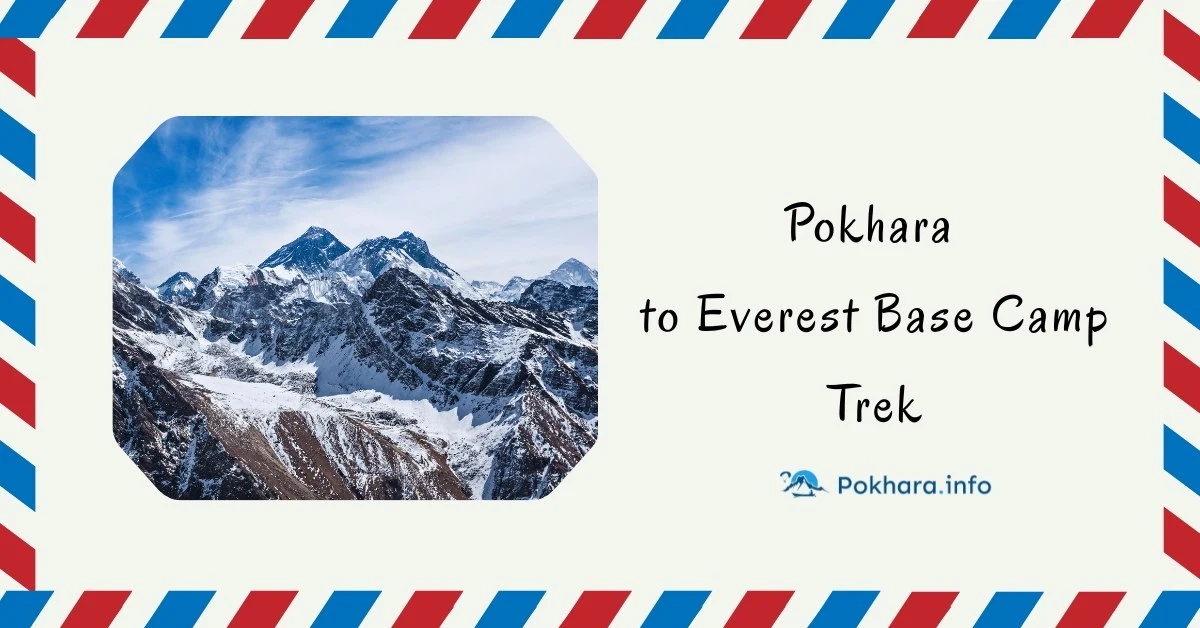
Pokhara to Everest Base Camp Trek
The Pokhara to Everest Base Camp Trek combines two of Nepal's most popular destinations into one Himalayan journey. The trip begins in Pokhara, but the actual Everest Base Camp trekking route does not start there.
Trekkers normally travel from Pokhara to Kathmandu first and then continue by air to Lukla, the gateway to the Everest region. From Lukla, the trail follows the Dudh Koshi Valley through Phakding and Namche Bazaar before climbing progressively higher toward Tengboche, Dingboche, Lobuche, Gorak Shep and finally Everest Base Camp.
The standard trek takes about 11 to 12 trekking days from Lukla and back, while the complete journey from Pokhara generally requires around 14 to 16 days, depending on flight connections, acclimatization, weather buffers and whether you return to Pokhara immediately after Kathmandu.
This is not a technical climb of Mount Everest. Everest Base Camp is reached by trekking to the foot of the mountain at approximately 5,364 meters, while the summit of Mount Everest is 8,848.86 meters above sea level. The major challenge for trekkers is therefore altitude, endurance and changing mountain conditions rather than technical climbing.
The route passes through the Sagarmatha National Park, Sherpa settlements, Buddhist monasteries, high mountain valleys and some of the world's most recognizable Himalayan landscapes. Nepal Tourism Board identifies Lukla as the main gateway and describes the route through Namche, Tengboche, Pheriche, Kala Patthar and Gorakshep toward Everest Base Camp.
Can You Trek to Everest Base Camp Directly From Pokhara?
No. There is no conventional trekking trail from Pokhara directly to Everest Base Camp.
Pokhara is in the Annapurna region of Nepal, while Everest Base Camp is in the Khumbu region in the northeast. The two destinations are separated by a considerable distance and different mountain regions.
For the standard Everest Base Camp itinerary, the practical route is:
Pokhara to Kathmandu to Lukla to Phakding to Namche Bazaar to Tengboche to Dingboche to Lobuche to Gorak Shep to Everest Base Camp
After reaching Base Camp, trekkers normally return along the same general route:
Everest Base Camp to Gorak Shep to Pheriche to Namche to Lukla to Kathmandu to Pokhara
The most common access point is Lukla. Nepal Tourism Board describes Lukla as the starting point for the Everest trail, with the route continuing through the Dudh Koshi Valley toward Namche Bazaar.
How Do You Get From Pokhara to Everest Base Camp?
The journey has three main parts:
1.
Pokhara to Kathmandu
You can travel from Pokhara to Kathmandu by:
Domestic flight
Tourist bus
Private vehicle
Flying is the fastest option and is particularly useful if you are working with a tight trekking schedule.
A road journey is possible, but it takes substantially longer and road conditions can affect travel time. If your EBC trek is scheduled immediately after reaching Kathmandu, leave sufficient buffer rather than relying on a tight road-to-flight connection.
2.
Kathmandu to Lukla
The standard EBC route begins with a flight toward Lukla Airport, situated at approximately 2,850 m.
Flight operations can vary with season, weather and airport scheduling. During some periods, trekkers may be routed through Ramechhap/Manthali rather than departing directly from Kathmandu.
This is important when planning a Pokhara departure because your international arrival, Pokhara-Kathmandu transfer and Lukla flight should not be arranged with zero flexibility.
3.
Lukla to Everest Base Camp
Once you land at Lukla, the trek begins.
The classic trail follows the Dudh Koshi Valley through:
Lukla to Phakding to Namche Bazaar to Tengboche to Dingboche to Lobuche to Gorak Shep to Everest Base Camp
You then return to Lukla before flying back toward Kathmandu.
Why Start an Everest Base Camp Trek From Pokhara?
For travelers already visiting Pokhara, adding Everest Base Camp creates an opportunity to experience two very different Himalayan environments in the same Nepal trip.
Pokhara is strongly associated with the Annapurna region, lakes, lower Himalayan viewpoints and adventure activities. Everest Base Camp, by contrast, takes you deep into the Khumbu, where the landscape becomes increasingly alpine and glaciated.
Starting from Pokhara also means you can spend time exploring Pokhara before beginning the high-altitude portion of the trip.
However, Pokhara does not make the Everest trek shorter. You still need to travel to Kathmandu and then reach Lukla or use an alternative overland approach.
What Is the Standard Pokhara to Everest Base Camp Route?
The classic route can be divided into several stages.
Stage 1: Pokhara to Kathmandu
This is the transportation portion of the journey rather than a trekking stage.
Pokhara to Kathmandu
Altitude changes are relatively insignificant compared with the trek itself.
Stage 2: Kathmandu to Lukla
A short mountain flight takes you to Lukla.
Lukla: approximately 2,850 m
The dramatic landscape begins almost immediately after landing.
Stage 3: Lukla to Namche Bazaar
The trail initially follows the Dudh Koshi River through forests and villages before climbing toward Namche.
Lukla to Phakding to Monjo to Namche Bazaar
Namche is the main commercial and acclimatization center of the Khumbu region. Nepal Tourism Board places Namche at approximately 3,500 m.
Stage 4: Namche to Dingboche
From Namche, the route continues through increasingly high mountain terrain.
Namche to Tengboche to Pangboche to Dingboche
Tengboche is particularly important because of its monastery and panoramic mountain surroundings.
Stage 5: Dingboche to Lobuche
The landscape changes significantly as the trail climbs above the tree line.
Dingboche to Duglha to Lobuche
Vegetation becomes sparse, temperatures drop and the effects of altitude become more noticeable.
Stage 6: Lobuche to Everest Base Camp
This is the major objective of the trek.
Lobuche to Gorak Shep to Everest Base Camp
The trail reaches Gorak Shep before continuing toward Base Camp beside the Khumbu Glacier.
Stage 7: Kala Patthar and Return
Many trekkers add Kala Patthar, which rises to approximately 5,545 m.
It is important to understand that Kala Patthar is not Everest Base Camp. It is a high viewpoint used to obtain expansive views of Everest and the surrounding peaks.
After Kala Patthar, trekkers descend toward Pheriche or another lower overnight point and begin the return journey.
Pokhara to Everest Base Camp Trek Itinerary
A 14-day itinerary from Pokhara is possible, but it requires reasonably reliable transport connections. A 15- or 16-day plan gives more practical weather and flight flexibility.
The following itinerary is designed as a balanced standard route rather than an unnecessarily compressed trek.
Day 1: Pokhara to Kathmandu
Altitude: Kathmandu, approximately 1,400 m
Travel from Pokhara to Kathmandu by flight or road.
If possible, treat Kathmandu as an overnight stop rather than attempting to connect immediately with a Lukla flight. This gives you a buffer if transportation from Pokhara is delayed.
Overnight: Kathmandu
Day 2: Kathmandu to Lukla and Trek to Phakding
Lukla: ~2,850 m
Phakding: ~2,610 m
Walking: approximately 3 to 4 hours
After reaching Lukla, the trek begins through the lower Khumbu.
The trail descends and climbs through small settlements and forested sections before reaching Phakding.
This is intentionally a short trekking day. The objective is not to cover maximum distance but to begin adapting to the altitude.
Overnight: Phakding
Day 3: Phakding to Namche Bazaar
Namche Bazaar: ~3,440 to 3,500 m
Walking: approximately 5 to 7 hours
The route continues along the Dudh Koshi River and enters Sagarmatha National Park around Monjo/Jorsale.
After crossing suspension bridges, the trail makes a sustained climb toward Namche Bazaar.
The final uphill section is considerably more demanding than the relatively easy first part of the day.
Namche is the principal trading and tourism center of the Khumbu region.
Overnight: Namche Bazaar
Day 4: Acclimatization Day at Namche
This is not a wasted day.
At high altitude, acclimatization is an essential part of the itinerary. Instead of gaining substantial elevation and sleeping higher, trekkers normally spend another night around Namche while taking a shorter acclimatization hike.
Possible activities include walking toward the Everest View Hotel, Khumjung or Khunde.
The idea is to climb higher during the day and return to Namche for the night.
Overnight: Namche Bazaar
Day 5: Namche Bazaar to Tengboche
Tengboche: approximately 3,860 m
Walking: approximately 5 to 6 hours
The trail leaves Namche and traverses the hillside with views toward Everest, Lhotse, Nuptse and Ama Dablam.
The route then descends toward the Dudh Koshi before climbing again toward Tengboche.
Tengboche is famous for its Buddhist monastery and its mountain setting.
Overnight: Tengboche
Day 6: Tengboche to Dingboche
Dingboche: approximately 4,410 m
Walking: approximately 5 to 6 hours
The trail passes through Pangboche and gradually enters the higher alpine environment.
As elevation increases, forests become thinner and the landscape opens into broad mountain valleys.
Ama Dablam is one of the most prominent peaks visible from this section.
Overnight: Dingboche
Day 7: Acclimatization Day at Dingboche
Altitude: approximately 4,410 m
Another acclimatization day is essential before pushing toward Lobuche and Gorak Shep.
A common strategy is a gradual hike to a higher viewpoint around Dingboche before returning to the village.
The exact acclimatization hike should depend on weather, physical condition and guide advice.
Overnight: Dingboche
Day 8: Dingboche to Lobuche
Lobuche: approximately 4,940 m
Walking: approximately 5 to 6 hours
The trail climbs toward Duglha and then continues into the increasingly barren landscape near Lobuche.
The Khumbu Glacier and surrounding high peaks become more prominent.
At this elevation, even relatively short climbs can feel difficult because of reduced oxygen availability.
Overnight: Lobuche
Day 9: Lobuche to Everest Base Camp via Gorak Shep
Gorak Shep: approximately 5,164 m
Everest Base Camp: approximately 5,364 m
Walking: approximately 7 to 9 hours depending on conditions
This is one of the most demanding days of the trek.
The trail climbs from Lobuche toward Gorak Shep. After a short break, trekkers continue toward Everest Base Camp.
The trail follows the moraine and glacial landscape toward the famous base camp area.
Important: Everest Base Camp is the destination of the trek, but it is not the summit of Everest and does not provide the same panoramic viewpoint of Everest that Kala Patthar does.
After returning to Gorak Shep, spend the night there.
Overnight: Gorak Shep
Day 10: Kala Patthar and Trek to Pheriche
Kala Patthar: approximately 5,545 m
Pheriche: approximately 4,240 m
Walking: approximately 6 to 8 hours
An early morning ascent of Kala Patthar is one of the highlights of the entire trek.
The viewpoint provides broad views toward Mount Everest, Nuptse, Lhotse and surrounding peaks.
After descending to Gorak Shep for breakfast, continue downhill toward Pheriche.
Descending is physically easier than climbing at this altitude, but the trail remains demanding.
Overnight: Pheriche
Day 11: Pheriche to Namche Bazaar
Namche: approximately 3,440 to 3,500 m
Walking: approximately 7 to 8 hours
The return route passes through familiar villages and lower elevations.
The descent brings noticeable changes in temperature and vegetation.
Continue toward Tengboche and then back to Namche.
Overnight: Namche Bazaar
Day 12: Namche Bazaar to Lukla
Lukla: approximately 2,850 m
Walking: approximately 7 to 9 hours
This is a long final trekking day.
The route retraces the Dudh Koshi Valley toward Phakding and eventually Lukla.
Depending on the exact route and walking speed, the day can feel tiring because of its length.
Overnight: Lukla
Day 13: Lukla to Kathmandu
Fly from Lukla toward Kathmandu or the airport being used for current Lukla operations.
Flight schedules are weather dependent, so keeping a spare day is strongly recommended.
Overnight: Kathmandu
Day 14: Kathmandu to Pokhara
Return to Pokhara by flight, tourist bus or private vehicle.
This marks the end of the standard Pokhara-to-Everest-Base-Camp journey.
Should You Make the Trek 15 or 16 Days?
Yes, if your schedule allows it.
A 14-day itinerary can work, but the Everest region is highly dependent on mountain weather and flight operations.
An additional one or two days can act as:
Flight-delay buffer
Bad-weather buffer
Extra acclimatization time
Recovery time
Contingency for illness or slow walking
Protection against missing an international flight
For a high-altitude trek involving Lukla flights, having no spare day is a planning risk.
How Difficult Is the Pokhara to Everest Base Camp Trek?
The Everest Base Camp Trek is generally considered challenging, primarily because of altitude, duration and sustained uphill and downhill walking.
It does not require technical mountaineering skills for the standard route. You do not need to climb Everest or cross a technical high-altitude pass.
However, the trek reaches above 5,000 m, and the combination of altitude, cold, long walking days and thinner air makes it considerably more demanding than many lower-altitude Nepal treks.
The biggest challenge is usually not the first few days. It is the combination of:
High elevation
Long walking days
Repeated ascents and descents
Cold temperatures
Reduced oxygen availability
Potential altitude sickness
Remote mountain conditions
Weather-related delays
Nepal Tourism Board specifically emphasizes the need for proper acclimatization because altitude gains become rapid in the Everest region.
What Is the Highest Point on the Everest Base Camp Trek?
There are two different elevations readers often confuse.
Everest Base Camp
Approximately 5,364 m
This is the destination of the standard trek.
Kala Patthar
Approximately 5,545 m
Kala Patthar is normally the highest point reached on the classic EBC itinerary.
Therefore, if someone asks, “What is the highest altitude of the Everest Base Camp Trek?â€, the practical answer is approximately 5,545 m if Kala Patthar is included.
If they mean the actual Base Camp, it is approximately 5,364 m.
How Long Is the Everest Base Camp Trek From Pokhara?
The complete Pokhara-based journey normally takes approximately 14 to 16 days.
The walking portion from Lukla to Everest Base Camp and back is generally around 11 to 12 trekking days, depending on the itinerary.
The total trekking distance is commonly around 125 to 135 km round trip, although the exact distance varies according to the route, acclimatization hikes and side trips.
This is why a simple “X km trek†figure can be misleading. Two itineraries can reach the same Base Camp while recording different distances because of different acclimatization routes and overnight stops.
What Permits Are Required for Everest Base Camp Trek?
For foreign trekkers, the main formal requirements include the Sagarmatha National Park entry permit and TIMS under the current trekking regulations.
Sagarmatha National Park Entry Permit
The current Nepal Tourism Board fee table lists the Sagarmatha National Park entry fee as:
Nepali citizens: NPR 100
SAARC nationals: NPR 1,500
Other foreign nationals: NPR 3,000
Children under 10: Free
Fees should always be reconfirmed before departure because government charges can change.
The permit can be obtained through the appropriate tourism service/entry arrangements, and permits are checked at checkpoints along the route.
Nepal Tourism Board specifically notes the Sagarmatha National Park checkpoint around Jorsale, where permits are checked.
TIMS Card
The current Nepal Tourism Board TIMS page specifically lists Everest Basecamp Trek among the routes requiring a licensed trekking guide and an agency-issued TIMS card.
The current listed TIMS charge is:
SAARC nationals: NPR 1,000
Other nationals: NPR 2,000
The TIMS card is arranged through a registered trekking agency under the current system.
Is a Guide Mandatory for Everest Base Camp?
Yes, under the current Nepal Tourism Board TIMS rules, Everest Base Camp Trek is among the routes requiring trekkers to be accompanied by a licensed trekking guide and to carry an agency-issued TIMS card.
This is an important point because older EBC articles frequently contain outdated information about independent trekking.
How Much Does the Pokhara to Everest Base Camp Trek Cost?
The cost depends heavily on whether you choose a basic group trek, private trek, premium lodge experience or additional transportation and services.
Current published 2026 EBC package prices commonly fall around US$1,200 to $1,700 per person for standard guided packages, although the exact inclusions vary considerably. Current examples include packages around US$1,195 to $1,299 and other standard packages around US$1,230 to $1,500.
Practical EBC Cost Range
Expense Category | Approximate Cost |
Standard guided EBC package | US$1,200 to $1,700 |
Pokhara to Kathmandu to Pokhara transport | Additional |
Personal spending | US$150 to $300+ |
Guide/porter tips | Additional |
Travel insurance | Additional |
Personal trekking equipment | Additional |
Emergency evacuation | Usually insurance-covered if valid |
International airfare | Not included |
Nepal visa | Not included |
A sensible planning budget for someone starting and ending in Pokhara would therefore be approximately US$1,400 to $2,000 per person, excluding international airfare, depending on package inclusions and personal spending.
Do not compare EBC packages based only on the headline price. Check whether the package includes:
Lukla flights
Guide
Porter
Accommodation
Meals
Sagarmatha National Park fee
TIMS
Airport transfers
Kathmandu accommodation
Domestic transportation
Insurance or evacuation
Extra acclimatization days
For example, one current 12-day package priced around US$1,230 includes domestic flights, accommodation, meals, guide and government expenses, while porter costs, tips, Wi-Fi, hot showers, charging and personal expenses are additional.
How Much Does a Guide and Porter Cost?
If arranged separately, current published estimates put a licensed trekking guide at approximately US$25 to $35 per day, while a porter may cost roughly US$20 to $25 per day, before tips.
Actual prices vary according to:
Experience
Certification
Season
Group size
Services provided
Porter-guide arrangement
Agency
Insurance and employment benefits
A responsible trekking budget should also include appropriate tips at the end of the trek.
Is Everest Base Camp Trek Suitable for Beginners?
Yes, a physically prepared beginner can complete the Everest Base Camp Trek, but it should not be treated as an easy first hike.
Previous high-altitude trekking experience is helpful but not mandatory. More important factors include:
Good cardiovascular fitness
Ability to walk 5 to 8 hours on consecutive days
Comfort with uphill and downhill walking
Adequate preparation
Proper acclimatization
Patience at high altitude
Willingness to slow down when necessary
The standard route does not require technical climbing ability. Current trekking operators also describe EBC as a trek rather than a technical climb.
The altitude is the part beginners should take most seriously.
What Fitness Level Do You Need for Everest Base Camp?
You do not need to be an elite athlete.
A good preparation target is to become comfortable with several hours of continuous walking while carrying a light daypack.
Useful Training
Start preparing around 8 to 12 weeks before the trek if possible.
Focus on:
Long-distance walking
Uphill walking
Stair climbing
Incline treadmill sessions
Leg strength
Core strength
Balance
Regular aerobic exercise
Weekend hikes are particularly useful because they help your body adapt to walking for several hours rather than exercising only for short periods.
Training should also include consecutive walking days occasionally. The EBC trek is different from completing one long hike and then resting for several days.
What Is Altitude Sickness and How Can You Reduce the Risk?
Altitude sickness can occur when the body does not adapt adequately to reduced oxygen availability at higher elevations. It can affect people regardless of age or fitness.
Common early symptoms can include:
Headache
Nausea
Dizziness
Unusual tiredness
Loss of appetite
Difficulty sleeping
More serious symptoms require immediate attention and descent. The most important preventive strategy on an EBC trek is proper acclimatization and controlled ascent.
What Should You Do if You Feel Sick at High Altitude?
Tell your guide immediately. Do not try to hide symptoms simply because you want to reach Base Camp.
Depending on the situation, the appropriate response may involve:
Resting
Stopping further ascent
Descending
Medical evaluation
Emergency evacuation
A trekking itinerary should never prioritize reaching Everest Base Camp over your health.
If you are considering altitude medication such as acetazolamide, discuss it with a qualified medical professional before the trek rather than self-prescribing.
What Is the Best Time for Pokhara to Everest Base Camp Trek?
The two most popular trekking periods are spring and autumn.
Spring: March to May
Spring generally offers:
Increasingly warmer conditions
Good mountain visibility
Rhododendron blooms at lower elevations
Busy trekking trails
Strong trekking conditions before the monsoon
March can still be cold at high altitude, while May gradually becomes warmer but can experience increasing cloud and pre-monsoon weather.
Autumn: September to November
Autumn is traditionally one of the strongest trekking periods.
Typical advantages include:
Clearer mountain views
Stable trekking conditions
Comfortable daytime temperatures at lower elevations
Excellent visibility
Busy trails
October and November are especially popular.
Winter: December to February
Winter trekking is possible.
However:
Nights become extremely cold.
Snow can affect high sections.
Daylight hours are shorter.
Some lodges may operate with reduced services.
Weather can be less predictable.
Winter is better suited to trekkers who are prepared for cold high-altitude conditions.
Monsoon: June to August
The Everest region can still be trekked during monsoon, but conditions are less predictable. Cloud, rain, wet trails and flight disruptions can complicate the journey.
For someone planning a first EBC trek, spring or autumn generally offers a simpler planning environment.
What Is the Weather Like During the Everest Base Camp Trek?
Weather changes dramatically with altitude.
At lower elevations, daytime conditions can be relatively mild during trekking seasons. At Gorak Shep and Base Camp, temperatures can fall significantly, especially at night and before sunrise.
Expect:
Strong sun during the day
Cold mornings
Freezing nights at high elevation
Strong winds
Rapid weather changes
Potential snowfall
Cloud and visibility changes
This is why a layered clothing system is more useful than carrying one extremely heavy jacket.
Where Do You Stay During the Everest Base Camp Trek?
The standard route is primarily a tea-house/lodge trek. You generally do not need to carry a tent and full camping kitchen.
Accommodation becomes more basic as you climb higher.
Typical facilities include:
Bed and mattress
Blanket
Dining room
Shared or private bathroom depending on lodge
Hot meals
Charging for an additional fee in many places
Wi-Fi in some locations
Rooms are generally basic, particularly at higher elevations.
At popular stops such as Namche, there are more accommodation choices. Above Dingboche and especially around Lobuche and Gorak Shep, options become more limited.
Nepal Tourism Board confirms that lodges and tea houses are widely available along the Everest Base Camp route.
What Food Is Available on the Everest Base Camp Trek?
Tea houses serve a surprisingly broad selection of food.
Common options include:
Dal bhat
Rice and vegetables
Noodles
Pasta
Momos
Sherpa stew
Potatoes
Eggs
Soup
Bread
Pancakes
Porridge
Tea
Coffee
Hot chocolate
Dal bhat remains one of the most practical choices because it provides carbohydrates and protein and is commonly available along the route.
At higher elevations, food prices increase because everything has to be transported into the mountains.
Can You Get Drinking Water on the EBC Trek?
Yes.
Water is available through:
Tea houses
Lodges
Refill stations
Bottled water
Filtered or treated sources
However, buying bottled water throughout the trek can become expensive and generates unnecessary plastic waste.
A reusable bottle or hydration system combined with a reliable water purification method is a more practical approach.
Is There Internet and Mobile Network on the Everest Base Camp Trek?
Connectivity is available in parts of the Everest region, but it should not be treated as guaranteed.
Signal quality varies according to:
Location
Weather
Network
Altitude
Infrastructure
Wi-Fi is available at many lodges, often for an additional charge.
Do not plan your trek around having continuous internet access.
Download important documents, maps, offline navigation data and emergency contacts before leaving Kathmandu.
Can You Charge Your Phone on the Everest Base Camp Trek?
Yes, but charging may cost extra, especially at higher elevations.
A power bank is strongly recommended.
You should also:
Carry spare batteries where applicable.
Reduce unnecessary screen use.
Keep electronics protected from cold and moisture.
Carry a suitable charging cable.
Avoid relying exclusively on lodge electricity.
What Should You Pack for Everest Base Camp?
The goal is to stay warm and dry without carrying unnecessary weight.
Clothing
Moisture-wicking base layers
Thermal underwear
Fleece or insulating mid-layer
Down or synthetic insulated jacket
Waterproof jacket
Waterproof trousers
Trekking trousers
Warm trekking socks
Gloves
Warm hat
Sun hat
Buff or neck warmer
Footwear
Broken-in trekking boots
Comfortable camp shoes
Several pairs of trekking socks
Optional gaiters depending on season
Do not start an EBC trek with brand-new boots.
Personal Equipment
Backpack
Daypack if using a porter
Sleeping bag suitable for cold temperatures
Water bottles
Water purification system
Headlamp
Sunglasses
Sunscreen
Lip balm with sun protection
Personal first-aid supplies
Toiletries
Power bank
Phone/camera
Trekking poles
Documents
Carry:
Passport
Copies of important documents
Insurance details
Emergency contacts
Permit/TIMS information
Flight information
Do You Need Travel Insurance for Everest Base Camp?
Travel insurance is strongly recommended. A suitable policy should specifically cover high-altitude trekking at the elevation of your planned route.
Check whether the policy covers:
Trekking above 5,000 m
Emergency medical treatment
Helicopter evacuation
Trip interruption
Flight delays
Lost baggage
Repatriation where applicable
Do not assume that a generic travel insurance policy automatically covers an EBC trek.
What Happens if Your Lukla Flight Is Cancelled?
This is one of the most important practical questions for an EBC trek.
Lukla flights can be disrupted by:
Poor visibility
Strong wind
Cloud
Weather
Airport operational restrictions
Aircraft availability
If your flight is cancelled, the options depend on the circumstances.
Possible solutions can include:
Rebooking a later flight
Waiting for better weather
Taking an alternative flight arrangement
Helicopter transfer, subject to weather, availability, regulation and additional cost
Changing the trekking itinerary
This is another reason to keep a buffer day before an important onward or international flight.
Can You Avoid the Lukla Flight?
Yes. There are longer approaches to the Everest region from the lower Solu area, including routes involving Jiri or road access toward the Solukhumbu region.
However, this adds several trekking days.
The Lukla approach remains the standard choice for travelers who want to complete the classic EBC trek within approximately two weeks.
Nepal Tourism Board also identifies the Jiri approach as an alternative way into the Everest region.
Can You Take a Helicopter Instead of Trekking to Everest Base Camp?
Helicopter-based EBC itineraries are available, but they are fundamentally different from the classic trek.
A helicopter option can reduce the number of trekking days, but it does not provide the same experience of walking through the Khumbu Valley, staying in Sherpa villages and gradually gaining altitude.
It can be considered by travelers with limited time or those who cannot undertake the full trek, subject to weather, aviation rules and operational availability.
What Are the Major Highlights of the Pokhara to Everest Base Camp Trek?
The trek is about much more than reaching one point.
Lukla: The gateway to the Everest region and the starting point of the classic trekking route.
Namche Bazaar: A major Sherpa trading center and one of the most recognizable settlements in the Khumbu.
Tengboche Monastery: One of the cultural highlights of the route, surrounded by spectacular Himalayan scenery.
Ama Dablam: One of the most recognizable peaks seen throughout the upper Khumbu.
Sagarmatha National Park: The route passes through the UNESCO-listed national park, known for its Himalayan landscapes and biodiversity.
Khumbu Glacier: The glacial landscape becomes increasingly prominent around Lobuche, Gorak Shep and Base Camp.
Everest Base Camp: The primary destination of the trek and the staging area for Everest climbing expeditions during the climbing season.
Kala Patthar: One of the most famous viewpoints on the route, offering expansive views toward Everest and neighboring peaks.
Nepal Tourism Board highlights Everest, Lhotse, Nuptse, Ama Dablam, Khumbu Glacier, Tengboche Monastery and Sherpa culture among the defining attractions of the Everest region.
What Mountains Can You See During the Trek?
Depending on weather and location, the route offers views of several major Himalayan peaks, including:
Mount Everest
Lhotse
Nuptse
Ama Dablam
Thamserku
Kongde
Pumori
Lobuche peaks
Cholatse
The mountain scenery changes as you move through the valley, which is one reason the return journey does not feel exactly the same as the ascent.
Is Everest Base Camp the Same as Climbing Mount Everest?
No.
This distinction is essential.
Everest Base Camp Trek = trekking to the base camp.
Everest Expedition = climbing Mount Everest.
Reaching Base Camp does not require technical mountaineering equipment or an Everest climbing permit.
Summiting Mount Everest requires an entirely different level of preparation, equipment, permits, expedition logistics and mountaineering experience.
How High Is Everest Base Camp Compared With Other Nepal Treks?
The elevation makes EBC significantly more demanding than many popular lower-altitude treks.
Trek | Approx. Highest Point |
Royal Trek | ~1,730 m |
Panchase Trek | ~2,500 m |
Ghorepani/Poon Hill | ~3,210 m |
Mardi Himal Trek | ~4,500 m |
Annapurna Base Camp | ~4,130 m |
Khopra Ridge | ~3,660 m |
Everest Base Camp | ~5,364 m |
Kala Patthar | ~5,545 m |
This comparison explains why EBC preparation and acclimatization deserve considerably more attention.
Is Everest Base Camp Trek Safe?
The trek is undertaken by many visitors each year, but it is still a serious high-altitude journey.
The main risks include:
Altitude sickness
Severe weather
Slippery or icy trails
Falls
Dehydration
Exhaustion
Flight cancellations
Cold exposure
Medical emergencies
Safety improves significantly when trekkers follow a sensible itinerary, use a licensed guide, monitor symptoms and avoid rushing the ascent.
The current requirement for a licensed guide on the EBC route also provides an important layer of local support and route knowledge
What Should You Not Do on the Everest Base Camp Trek?
Avoid these common mistakes:
Do Not Rush the Acclimatization Days: Removing acclimatization days to save time can make the trek unnecessarily risky.
Do Not Ignore Symptoms: A headache or unusual fatigue may be an early warning that should be discussed with your guide.
Do Not Pack Excessively: A heavy backpack makes every uphill section harder.
Do Not Depend on Flights Working Perfectly: Always keep a weather buffer.
Do Not Treat Base Camp as the Only Goal: The trek is a journey through the Khumbu, not simply a race to take a photograph at Base Camp.
Do Not Underestimate the Descent: Returning downhill after reaching Base Camp still requires several long trekking days.
What Is the Best Way to Prepare for Everest Base Camp?
A good preparation plan combines fitness, equipment, altitude awareness and logistics.
8 to 12 Weeks Before
Build cardiovascular fitness through:
Long walks
Running or cycling
Stair climbing
Incline treadmill
Hiking
4 to 6 Weeks Before
Add longer weekend hikes and practice carrying the backpack you expect to use.
1 to 2 Weeks Before
Avoid trying to build fitness through extreme last-minute training.
Instead:
Confirm permits
Confirm flights
Check insurance
Test equipment
Break in boots
Check weather
Prepare documents
Confirm your guide/agency arrangements
Pokhara to Everest Base Camp Trek: Budget vs Standard vs Private
The price difference is usually determined by the level of service rather than the mountain itself.
Trek Style | Approximate Planning Range | Usually Suited To |
Budget/group | US$1,200 to $1,350 | Cost-conscious trekkers |
Standard guided | US$1,350 to $1,600 | Most travelers |
Private/small group | US$1,500 to $1,900+ | More flexibility |
Premium/luxury | US$2,000+ | Travelers prioritizing comfort |
These are planning ranges rather than fixed market rates. Published 2026 packages show substantial variation depending on group size and inclusions.
What Is Included in a Typical EBC Trek Package?
A standard package may include:
Licensed trekking guide
Porter
Lukla flights
Tea-house accommodation
Meals during the trek
Sagarmatha National Park fee
TIMS
Airport transfers
Some Kathmandu accommodation
Government taxes
Agency service charges
But not every company includes everything. Always ask for an itemized itinerary before booking.
What Is Usually Not Included?
Common exclusions include:
International airfare
Nepal visa
Travel insurance
Personal trekking equipment
Personal snacks
Bottled water
Wi-Fi
Hot showers
Device charging
Laundry
Alcohol
Tips
Emergency evacuation
Additional hotel nights caused by flight delays
This is why the advertised package price should not be confused with your complete trip budget.
How Much Cash Should You Carry?
Even when digital payment options exist, cash remains useful in the mountains.
Carry enough Nepalese rupees for:
Drinks
Snacks
Charging
Wi-Fi
Showers
Laundry
Tips
Unexpected expenses
The exact amount depends on what your package covers.
A reasonable personal spending allowance is often US$150 to $300 or more, especially if you regularly purchase hot drinks, snacks, Wi-Fi and charging services.
Can You Do Everest Base Camp Trek Without a Porter?
Yes, but the current guide requirement is different from the question of carrying your own bag.
You can arrange a licensed guide while carrying your own backpack if your physical condition and packing strategy make that comfortable.
However, many trekkers choose a porter because carrying a lighter daypack makes long ascents significantly easier.
A porter can also provide valuable local support.
Can Older People Do the Everest Base Camp Trek?
Age alone does not determine whether someone can complete EBC.
The more useful questions are:
Can you walk for several hours on consecutive days?
Can you tolerate sustained uphill walking?
Can you prepare adequately?
Are you medically suitable for high-altitude trekking?
Can you follow a gradual acclimatization schedule?
Anyone with relevant medical concerns should discuss high-altitude travel with a qualified medical professional before booking the trek.
Can You Do Everest Base Camp Trek With Children?
It is possible for some older, well-prepared children and families, but EBC is not a casual family hike. The altitude, cold, long walking days and limited medical facilities require careful planning.
Families should consider:
Child's trekking experience
Physical ability
Acclimatization
Medical advice
Weather
Emergency evacuation
Flexible itinerary
A shorter Everest-region trek may be more appropriate for families who are uncertain about a full EBC itinerary.
What Is the Difference Between Everest Base Camp and Everest View Trek?
The Everest Base Camp Trek takes you all the way to approximately 5,364 m. The Everest View Trek is substantially shorter and remains at lower elevations while still providing views of Everest and other Himalayan peaks.
If the goal is specifically to stand at Everest Base Camp, choose the full EBC itinerary.
If your priority is experiencing the Sherpa region and seeing Everest without spending two weeks at high altitude, an Everest View-style trek is a different option.
Is Kala Patthar Worth Adding to the EBC Trek?
For trekkers following the classic route, Kala Patthar is commonly included because it offers one of the most expansive viewpoints toward Mount Everest. It also reaches approximately 5,545 m, making it the highest point of many standard EBC itineraries.
However, the climb is physically demanding because it begins from an already high elevation.
The decision should depend on weather, health and the guidance of your trekking guide.
How Much Walking Is There Each Day?
Most standard trekking days involve approximately 5 to 8 hours of walking, although the exact time varies with:
Distance
Elevation gain
Trail conditions
Weather
Group pace
Rest breaks
The longest days are generally around the Base Camp/Kala Patthar section and the return from Namche to Lukla.
What Language Is Spoken Along the EBC Route?
Nepali is widely spoken, while Sherpa communities have their own language and cultural traditions. English is also commonly understood in the trekking and hospitality industry, particularly in major villages and lodges.
Learning simple Nepali greetings and respectful local phrases is appreciated.
What Culture Will You Experience?
The trek passes through communities strongly influenced by Sherpa culture and Tibetan Buddhism.
You will encounter:
Buddhist monasteries
Prayer wheels
Mani stones
Prayer flags
Chortens
Sherpa villages
Traditional mountain architecture
Monastic traditions
Respect local customs. Walk clockwise around religious monuments where appropriate, avoid touching sacred objects casually and ask before photographing people or religious ceremonies.
Is the Everest Base Camp Trek Environmentally Responsible?
The Khumbu receives a large number of trekkers, making responsible travel important.
Simple actions make a difference:
Carry a reusable bottle.
Minimize single-use plastic.
Carry personal waste until proper disposal is available.
Stay on established trails.
Do not remove stones, plants or religious objects.
Respect wildlife.
Use water carefully.
Avoid unnecessary fires.
Support local lodges and businesses.
Follow your guide's environmental instructions.
The Everest region is not simply a scenic backdrop. It is a living landscape and home to communities whose livelihoods are closely connected to tourism.
What Makes the Pokhara to Everest Base Camp Trek Special?
The most compelling part of this journey is the gradual transformation of the landscape.
The trip begins around Pokhara's lower Himalayan environment, moves through Kathmandu, reaches the small mountain airstrip at Lukla and then enters the Khumbu on foot. The trail changes from forest and river valleys to alpine terrain and eventually to the glacial landscape surrounding Everest Base Camp.
You experience:
Pokhara to Kathmandu to Lukla to Sherpa villages to Namche to Buddhist monasteries to high alpine valleys to Khumbu Glacier to Everest Base Camp to Kala Patthar
That progression is what makes the journey more than simply a hike to a famous destination.
Final Planning Checklist for Pokhara to Everest Base Camp
Before leaving Pokhara, make sure you have:
A confirmed EBC itinerary
Licensed guide arrangement
TIMS arrangement
Sagarmatha National Park entry arrangements
Lukla flight confirmation
Travel insurance
High-altitude medical coverage
Proper trekking boots
Warm layers
Waterproof clothing
Sleeping bag
Water purification system
Headlamp
Power bank
Sunscreen and sunglasses
Personal medication
Passport and copies
Emergency contact information
Adequate Nepalese cash
At least one contingency day if your overall schedule allows
Conclusion
The Pokhara to Everest Base Camp Trek is not a direct trail from Pokhara to the world's highest mountain. It is a multi-stage Himalayan journey that takes you from Pokhara to Kathmandu, onward to Lukla and then deep into the Khumbu Valley on foot.
The classic route passes through Phakding, Namche Bazaar, Tengboche, Dingboche, Lobuche and Gorak Shep before reaching Everest Base Camp at approximately 5,364 m. Adding Kala Patthar takes the route to around 5,545 m and provides one of the most expansive viewpoints toward Mount Everest.
For most travelers, 14 to 16 days from Pokhara is a sensible planning window. A standard guided trek generally costs around US$1,200 to $1,700 from Kathmandu, with additional expenses required for Pokhara transfers, personal spending, insurance and other extras.
The most important part of planning is not simply choosing the cheapest package or shortest itinerary. It is allowing enough time for acclimatization, keeping flexibility for Lukla flights, using the required licensed guide, carrying appropriate equipment and treating the altitude seriously.
With the right preparation, the journey from Pokhara to Everest Base Camp becomes a progression through Nepal's landscapes and cultures rather than simply a race toward one famous destination.
Frequently Asked Questions
How many days does it take from Pokhara to Everest Base Camp?
A practical complete journey takes around 14 to 16 days, including transportation between Pokhara and Kathmandu, Lukla flights, acclimatization days and the return journey.
Can I go directly from Pokhara to Lukla?
There is no standard scheduled direct Pokhara-to-Lukla route used for the classic EBC itinerary. The normal approach is through Kathmandu, with current flight operations potentially routing through Ramechhap/Manthali.
Where does the Everest Base Camp Trek actually start?
The classic trek starts at Lukla, at approximately 2,850 m.
How high is Everest Base Camp?
Everest Base Camp on the Nepal side is approximately 5,364 m above sea level.
What is the highest point of the EBC trek?
If Kala Patthar is included, the highest point is approximately 5,545 m.
Is Everest Base Camp Trek difficult?
Yes. It is a challenging high-altitude trek because of elevation, long walking days, cold temperatures and the need for acclimatization.
Can beginners do Everest Base Camp Trek?
Yes, physically prepared beginners can complete it. Previous high-altitude experience is helpful but not essential.
Is a guide mandatory for Everest Base Camp?
Yes. Current Nepal Tourism Board rules specifically list Everest Base Camp Trek among routes requiring a licensed guide and agency-issued TIMS card.
How much does Everest Base Camp Trek cost?
Current standard guided packages commonly range around US$1,200 to $1,700 per person, depending on group size and inclusions. From Pokhara, allow additional money for transportation between Pokhara and Kathmandu and personal expenses.
What is the best month for Everest Base Camp Trek?
October, November, April and May are among the most popular periods, although March and September can also provide good trekking conditions depending on the year.
Is Everest Base Camp Trek open in winter?
Yes, but winter brings much colder temperatures, shorter days and potential snow or weather disruptions.
Can I do EBC during monsoon?
Yes, but rain, cloud and flight disruptions make monsoon less predictable than spring or autumn.
Do I need a tent?
No. The standard EBC route is primarily a tea-house/lodge trek.
Do I need climbing experience?
No. The standard Everest Base Camp Trek does not require technical mountaineering skills.
Do I climb Mount Everest?
No. You trek to Everest Base Camp. You do not climb Mount Everest.
Is Kala Patthar higher than Everest Base Camp?
Yes. Kala Patthar is approximately 5,545 m, while Everest Base Camp is approximately 5,364 m.
Can I see Mount Everest from Base Camp?
Everest Base Camp is at the foot of the mountain, but surrounding terrain means Kala Patthar is generally used for the classic broad panorama of Everest.
What happens if my Lukla flight is cancelled?
You may need to wait, rebook, change the itinerary or consider an alternative flight arrangement, depending on weather and availability. Keep a buffer day in your overall itinerary.
How much should I budget for personal expenses?
Around US$150 to $300+ is a practical starting allowance for personal expenses, although actual spending varies substantially.
Is travel insurance necessary?
It is strongly recommended, particularly insurance that explicitly covers high-altitude trekking and emergency evacuation.
How far do you walk each day?
Most days involve approximately 5 to 8 hours of walking, although some days are shorter and others considerably longer.