Trek Duration: About 7 to 10 days
Trek Grade: Moderate
Highest Point: Pangsang Pass, approximately 3,830 to 3,845 m
Region: Ganesh Himal / Ruby Valley, between the Langtang and Manaslu regions
Starting Point: Kathmandu
Ending Point: Kathmandu
Accommodation: Homestays and basic teahouses/lodges
Best Seasons: Spring and autumn; some operators also recommend February to June and September to December
Transportation: Public bus, shared jeep or private vehicle
Permits: TIMS and applicable local/conservation-area permits; confirm current requirements before departure
Guide: Plan the trek with a licensed guide
Maximum Altitude: Around 3,842 m at Pangsang Pass
Route, road conditions, accommodation and permit requirements can change, so confirm the current arrangements before departure.
Introduction
The Kathmandu to Ruby Valley Trek is a different kind of Himalayan trekking experience. It does not take you toward a famous base camp or a single iconic mountain destination.
Instead, the route crosses the remote hills of the Ganesh Himal region, connecting traditional settlements, forests, mountain viewpoints, high pastures and the challenging Pangsang Pass.
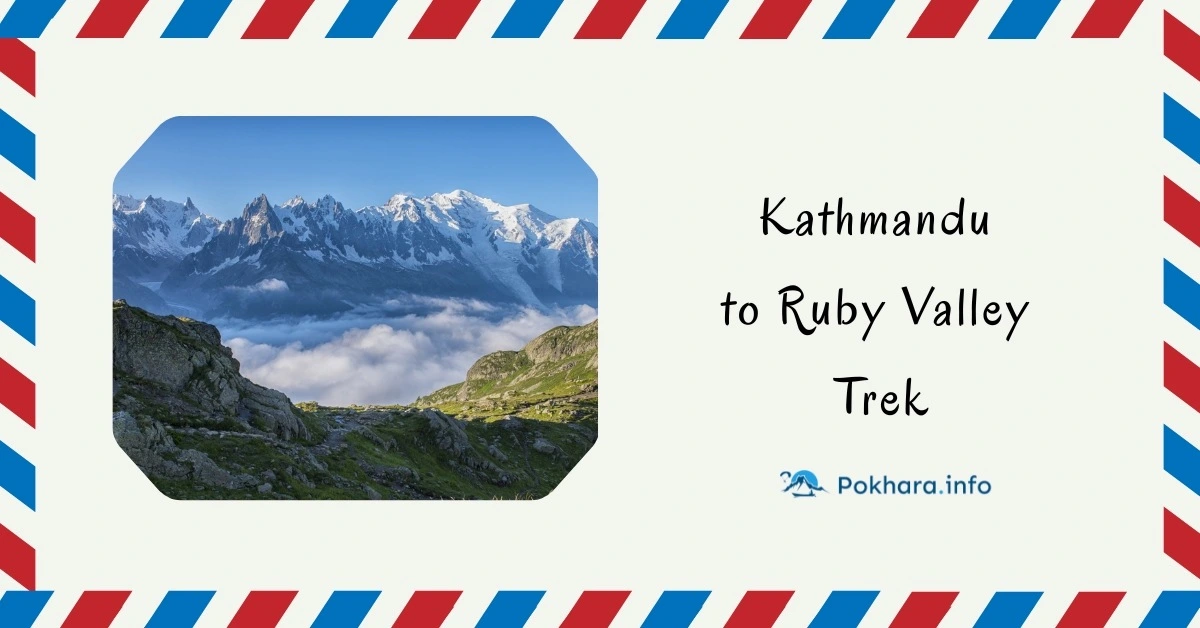
Ruby Valley lies in Nepal's north-central hills, in and around Dhading, between the Langtang National Park and Manaslu Conservation Area. The trekking route is known for its relatively quiet trails, Tamang and Gurung communities, traditional villages and views toward the Ganesh Himal, Langtang and Manaslu ranges.
What makes this trek particularly interesting is the combination of remote rural life and highland landscapes. Rather than moving from one heavily developed trekking settlement to another, trekkers spend much of the journey in areas where tourism infrastructure remains basic.
The route is therefore better suited to travelers who want to experience a less-commercialized side of Nepal and are comfortable with long overland journeys, simple accommodation and changing trail conditions.
What Is the Kathmandu to Ruby Valley Trek?
The Kathmandu to Ruby Valley Trek is an overland-and-hiking journey from Nepal's capital into the Ruby Valley/Ganesh Himal area.
There is no single universally fixed itinerary for the trek. Different routes use different trailheads and exit points, which is why published itineraries range from roughly 7 to 12 days.
A commonly used route travels through the Syabrubesi to Gatlang to Somdang to Pangsang Pass to Tipling corridor before continuing toward the Dhading side and returning to Kathmandu.
One important point is worth clarifying: Ruby Valley is not a trek from Kathmandu that can realistically be completed in only a few days.
A substantial portion of the journey is spent reaching and leaving the remote trail. The actual trekking section then requires several days to cross the valley and its surrounding highlands.
Current trekking itineraries commonly allow 7 to 10 days or more for the complete experience.
This makes Ruby Valley better suited to travelers who have enough time to explore beyond Nepal's most established trekking routes.
Where Is Ruby Valley?
Ruby Valley is located in the Dhading area of Bagmati Province, in the Ganesh Himal region of central Nepal.
The trekking area sits between two major protected landscapes, the Langtang National Park and the Manaslu Conservation Area, although the exact route does not necessarily pass through both protected areas on every itinerary.
The region is characterized by:
High hills and mountain valleys
Terraced farmland
Rhododendron and other mountain forests
Traditional villages
Waterfalls and streams
High-altitude pasture
Mountain viewpoints
Tamang and Gurung settlements
Remote communities with limited tourism infrastructure
The route's highest commonly cited point is Pangsang Pass (Pansang La), around 3,842 m.
Why Trek from Kathmandu to Ruby Valley?
Ruby Valley is worth considering if you have already experienced Nepal's more established trekking corridors and want something quieter. The main attraction is not simply the mountain scenery. It is the combination of landscape, culture and remoteness.
A Less-Crowded Trekking Experience
Ruby Valley receives considerably fewer trekkers than Nepal's major routes such as Everest Base Camp and the Annapurna Circuit. That does not mean you will have the mountains completely to yourself, but the route generally offers a quieter experience and fewer developed trekking settlements.
For travelers who dislike heavily commercialized trails, this can be one of the trek's biggest advantages.
Experience Tamang and Gurung Communities
The cultural component is one of the strongest reasons to choose Ruby Valley.
Villages along different versions of the route are home to communities including Tamang and Gurung people, alongside other ethnic groups. Traditional houses, agricultural practices, local food and community-run accommodation give trekkers opportunities to experience rural life more directly.
This is not simply a mountain-view trek. Much of its character comes from moving between communities and seeing how people live in a geographically isolated part of Nepal.
Cross Pangsang Pass
For many trekkers, Pangsang Pass is the defining physical feature of the route. At approximately 3,842 m, the pass provides broad mountain views and represents the highest point on the commonly described Ruby Valley route.
Reaching the pass also changes the character of the trek. The route becomes more alpine and exposed compared with the lower village sections.
Mountain Views Without an Extreme Altitude
Ruby Valley provides views toward several Himalayan ranges, including Ganesh Himal, Langtang and Manaslu, with some routes also offering broader Himalayan panoramas.
At roughly 3,842 m, Pangsang Pass is high enough to create genuine altitude considerations but considerably lower than Nepal's famous 5,000 m-plus trekking passes.
That does not mean altitude can be ignored. The route still involves substantial elevation gain and demanding walking days.
Kathmandu to Ruby Valley Trek Route
There are several variations of the Ruby Valley route. The itinerary below represents a practical Kathmandu-based route through Syabrubesi, Gatlang, Somdang, Pangsang Pass and Tipling.
Kathmandu to Syabrubesi to Gatlang to Somdang to Pangsang Pass to Tipling to Dhading side to Kathmandu
The exact villages used for overnight stops can change because of road conditions, local accommodation availability and the condition of the trekking trail.
A current trekking itinerary from Kathmandu, for example, describes the route through Syabrubesi, Gatlang, Somdang and Pangsang Pass before reaching Tipling, followed by the return journey toward Kathmandu.
Kathmandu to Ruby Valley Trek Itinerary
Day 1: Kathmandu to Syabrubesi
The journey begins with an overland drive from Kathmandu toward Syabrubesi.
This is primarily a transportation day rather than a trekking day. The road gradually leaves the Kathmandu Valley and enters the hill country, with changing landscapes of cultivated terraces, rivers, forests and mountain settlements.
Syabrubesi is commonly used as the gateway for several trekking routes in the Langtang and Ganesh Himal areas.
Overnight: Syabrubesi
Activity: Drive
Day 2: Syabrubesi to Gatlang
The trekking section begins as you leave Syabrubesi and head toward Gatlang, a traditional Tamang settlement.
The trail passes through hilly terrain and forested sections before reaching the village. Gatlang is known for its traditional settlement character and is an important cultural stop on this version of the Ruby Valley route.
This is where the trek begins to feel distinctly different from a conventional tourist itinerary: the emphasis shifts from simply reaching a famous viewpoint to experiencing the villages and landscapes along the route.
Overnight: Gatlang
Activity: Trek
Day 3: Gatlang to Somdang
The trail continues toward Somdang, gradually gaining elevation.
The landscape changes as you move away from the lower villages. Forests, mountain slopes and increasingly open terrain become more prominent.
This section is also part of what makes Ruby Valley physically demanding. The route is not a continuous flat walk between villages; there are substantial climbs and descents along the way.
Overnight: Somdang
Activity: Trek
Day 4: Somdang to Pangsang Pass and onward toward Tipling
This is one of the most demanding and memorable sections of the trek.
The route climbs toward Pangsang Pass, reaching approximately 3,842 m. From the pass, trekkers can experience expansive views toward the surrounding Himalayan ranges before descending toward the next settlement.
Because this is the highest section of the route, weather and trail conditions matter considerably. Snow, rain, wind or poor visibility can affect the crossing depending on the season.
Overnight: Tipling or another designated settlement, depending on the itinerary
Activity: Trek
Highest point: Approximately 3,842 m
Day 5 onward: Tipling and the Dhading Side
After crossing Pangsang Pass, the route continues through the villages on the southern/western side of the Ruby Valley trekking corridor.
Depending on the itinerary, trekkers may pass through settlements such as Chalis Gaon, Borang and Darkha before reaching a roadhead. From there, the return journey continues by vehicle.
This is another reason it is difficult to assign one universal number of trekking days to Ruby Valley: the trailhead and exit point can vary, and road access has changed the way some itineraries are organized.
How Difficult Is the Kathmandu to Ruby Valley Trek?
The Ruby Valley Trek is best described as moderate, although some operators classify particular itineraries as more demanding. The difficulty comes less from extreme altitude and more from the combination of remote trails, long walking days, elevation changes and limited infrastructure.
You should be prepared for:
Long ascents and descents
Uneven and sometimes rough trails
Several hours of walking on trekking days
A high point of approximately 3,842 m
Changing mountain weather
Basic accommodation
Limited services in remote villages
Long road journeys at the beginning and end
You do not need to be an experienced mountaineer. However, the trek should not be treated as a casual village walk either.
Regular hiking, walking or cardiovascular exercise before the trek will make the long days considerably easier.
Who Should Consider the Ruby Valley Trek?
The trek is particularly suitable for travelers who:
Want a quieter alternative to Nepal's major trekking routes: Ruby Valley provides a more remote experience than the country's busiest trekking corridors.
Enjoy cultural trekking: The villages and local communities are as important to the experience as the mountain scenery.
Are comfortable with basic infrastructure: Accommodation and facilities are considerably simpler than what you may find on highly developed trekking routes.
Have enough time for an overland-and-trekking journey: This is not an ideal choice if you only have two or three days available from Kathmandu.
Want a moderate Himalayan trek rather than a technical expedition: The route reaches around 3,842 m but does not require mountaineering skills.
Ruby Valley Trek: Permits, Cost, Best Time, Packing, Accommodation & Food
The Kathmandu to Ruby Valley Trek is best approached as a remote, moderate Himalayan trek rather than a conventional lodge-to-lodge holiday.
The Nepal Tourism Board itself identifies the Ganesh Himal to Ruby Valley area as a trekking region and describes the route through rhododendron forests, meadows, traditional villages and Tamang communities.
The most important thing to understand before booking is that Ruby Valley does not have one fixed itinerary. Road access and the choice of trailhead can change the number of trekking days.
A route using Syabrubesi, Gatlang, Somdang and Pangsang Pass is one established version, while other itineraries approach Ruby Valley from the Dhading side. The information below therefore focuses on what travelers actually need to plan rather than presenting one itinerary as universally fixed.
Ruby Valley Trek Permits: What Do You Actually Need?
This is an area where older Ruby Valley articles often contain outdated or conflicting information.
The Nepal Tourism Board currently lists Ganesh Himal to Ruby Valley Trek among the routes requiring a trekking guide and TIMS card. Its current TIMS information states that trekkers on listed routes must arrange the guide and TIMS through a government-registered trekking agency.
The listed TIMS charge is NPR 1,000 for SAARC nationals and NPR 2,000 for other nationals.
However, the exact additional entry or conservation-area requirement depends on the route you choose.
This matters because not every Ruby Valley itinerary follows exactly the same trail. For example, a route approaching through Syabrubesi may involve the Langtang National Park area, while a Ruby Valley itinerary entirely on the Dhading side may have different permit requirements.
What you should do
Before departure, ask your trekking agency to confirm:
TIMS requirement
Current TIMS fee
Whether your exact route enters Langtang National Park
Any local or rural-municipality entry fee
Whether additional registration is required at checkpoints
Which permits are included in your package
Is a Guide Mandatory for the Ruby Valley Trek?
For foreign trekkers following the Ganesh Himal to Ruby Valley route listed by the Nepal Tourism Board, the current TIMS rules require a licensed trekking guide. The Nepal Tourism Board specifically includes Ganesh Himal to Ruby Valley among the routes covered by the mandatory guide/TIMS provision.
There is also a practical reason for using a guide beyond the regulation itself.
Ruby Valley is considerably less developed than Nepal's major trekking routes. Trail conditions can change, accommodation is limited in some sections and road access has altered portions of established trekking itineraries.
A knowledgeable local guide can therefore help with:
Route navigation
Local accommodation
Weather-related decisions
Pangsang Pass conditions
Communication with local communities
Emergency arrangements
Permit and checkpoint procedures
For this trek, a guide is not merely someone who walks ahead of the group. Local knowledge can make a significant difference when conditions change.
How Much Does the Kathmandu to Ruby Valley Trek Cost?
There is no single official price for the Ruby Valley Trek.
The final cost depends on whether you use public transportation, a shared jeep or private transportation, how many trekking days you take, group size, guide and porter services, accommodation and what your trekking package includes.
Recent 2026 trekking estimates place a complete Ruby Valley trip broadly around USD 600 to 950 per person, although prices can be higher for private groups or more comfortable arrangements.
A package quote should clearly state whether it includes:
Kathmandu transportation
Guide
Porter
Conservation or local entry fees
Accommodation
Meals
Drinking water
Ground transportation
Insurance
Emergency evacuation
Kathmandu hotel nights
Do not compare Ruby Valley prices by headline price alone.
A USD 600 package that excludes transportation and permits may ultimately cost more than an USD 800 package that includes the major trekking expenses.
Best Time for the Kathmandu to Ruby Valley Trek
Spring and autumn are the safest choices for most trekkers.
Spring: March to May
Spring brings relatively favorable trekking conditions and is particularly attractive because the forests of the Ganesh Himal area become colorful with rhododendron blooms. Everyone specifically highlights the rhododendron forests of the Ruby Valley/Ganesh Himal region.
March and April generally provide good opportunities for mountain views, while May can become warmer at lower elevations.
Autumn: September to November
Autumn is another excellent period because the monsoon has usually cleared the atmosphere, improving visibility toward the Himalayan ranges. October and November are particularly attractive for trekkers who prioritize clear mountain views and relatively stable conditions.
Winter: December to February
Winter is possible, but it requires more preparation.
The higher parts of the route can experience snow and very cold conditions. Pangsang is particularly important in this respect.
That sections of the Ganesh Himal route can experience heavy snowfall and is recommended to carry appropriate cold-weather equipment.
Monsoon: June to August
The monsoon is generally the least convenient period for this trek.
Heavy rain can make remote trails muddy and slippery, while cloud, rain and poor visibility can reduce the quality of mountain views. Road travel to and from the trail can also become more complicated during periods of heavy rainfall.
Best overall: March to May and September to November
Most reliable choices for views: October to November and March to April
What Should You Pack for Ruby Valley?
Your packing list should reflect the fact that this is a remote trek with a high pass and limited infrastructure.
Clothing
Pack layers rather than relying on one heavy jacket.
A practical system includes:
Moisture-wicking base layer
Fleece or insulating mid-layer
Warm down or synthetic jacket
Waterproof/windproof outer layer
Trekking trousers
Warm thermal bottoms
Gloves
Warm hat
Sun hat
The weather can change quickly, particularly around higher sections of the route.
Footwear
Use well-broken-in trekking shoes or boots with good grip. bThe trail can include uneven ground, steep sections and wet conditions. Comfortable footwear becomes particularly important during long descents.
Essential Equipment
Carry:
Backpack
Sleeping bag suitable for expected temperatures
Headlamp
Trekking poles
Water bottles
Water purification tablets/filter
Sunscreen
Sunglasses
Personal first-aid supplies
Personal medication
Rain gear
Power bank
Small towel
Toiletries
Passport and required documents
Do not underestimate the sleeping bag. Even if your itinerary advertises tea-house accommodation, conditions can be cold at higher elevations and accommodation may be basic.
A good sleeping bag provides useful backup when rooms or blankets are inadequate.
Accommodation on the Ruby Valley Trek
Ruby Valley does not have the extensive tea-house network found on routes such as the Annapurna Circuit or Everest Base Camp. Accommodation varies according to the route.
You may stay in:
Homestays
Community-based accommodation is an important part of the experience in several villages. Facilities are generally basic, but staying with local families provides a closer look at village life and allows tourism income to reach local communities.
Basic Tea Houses or Lodges
Some settlements have simple lodges or tea houses offering beds and meals. Do not expect the same level of infrastructure available in major trekking hubs.
Camping
Camping may still be necessary on less-developed sections.
This is particularly important around Pangsang, where the lodge accommodation is not currently available on its described route and recommends carrying a tent or being prepared for extremely basic shelter. It also recommends carrying dry food because villages are sparse in parts of the route.
This is one of the biggest differences between Ruby Valley and popular tea-house treks.
Before starting, confirm exactly where your group will sleep each night.
Food and Drinking Water
Food availability is more limited than on Nepal's major trekking routes.
In villages, meals may include familiar Nepali staples such as:
Dal bhat
Rice and vegetables
Noodles
Soup
Potatoes
Momos
Eggs
Simple local dishes
The selection depends heavily on the settlement and season.
Because the route is remote, it is advised to trekkers to carry dry food and snacks for sections where villages and food supplies are limited.
Carry your own trail snacks
Useful options include:
Energy bars
Nuts
Dried fruit
Chocolate
Biscuits
Electrolyte packets
For water, carry a reusable bottle and use a reliable purification method when treated drinking water is not available.
Altitude and Pangsang Pass
Altitude is one of the most important considerations on the Ruby Valley Trek.
The commonly described Pangsang Pass section reaches roughly 3,830 to 3,850 m, although the Ganesh Himal route description gives 4,400 m for Pangsang Kharka, demonstrating why travelers should distinguish between different route variants and pass names rather than treating every published altitude as interchangeable.
Do not assume the highest altitude is always 3,842 m simply because that number appears repeatedly online. The exact route determines the maximum elevation.
At these elevations, altitude-related symptoms are possible.
Common early symptoms can include:
Headache
Nausea
Dizziness
Unusual tiredness
Reduced appetite
Difficulty sleeping
The safest response to worsening altitude symptoms is not to continue climbing. Inform your guide and descend if necessary.
Physical Preparation for the Trek
You do not need mountaineering experience for a standard Ruby Valley Trek, but you should be comfortable walking for several hours on consecutive days.
Start preparing several weeks before departure. Walking, hiking, stair climbing and cardiovascular exercise can improve your endurance.
More importantly, practice walking uphill and downhill. Ruby Valley's challenge is not simply distance; the trail repeatedly gains and loses elevation.
If you normally live in a flat area, stair training can be particularly useful.
What Makes Ruby Valley Different from Other Nepal Treks?
Ruby Valley's biggest strength is also what makes it less convenient. It is less developed.
That means:
Fewer crowds, but also fewer services.
More authentic village experiences, but simpler accommodation.
Remote landscapes, but longer road journeys and more difficult logistics.
A quieter trail, but less predictable infrastructure.
High mountain scenery, without requiring a technical climbing expedition.
The Nepal Tourism Board describes the Ganesh Himal/Ruby Valley route specifically in terms of its forests, meadows, mountain scenery and encounters with Tamang communities.
That combination is the real reason to choose this trek.
Responsible Trekking in Ruby Valley
Because tourism infrastructure remains limited, responsible travel matters even more here.
Stay locally: Choose locally operated homestays and lodges whenever possible. Your spending can directly support communities along the trail.
Carry reusable water bottles: Reduce disposable plastic wherever practical.
Take your waste with you: Do not assume that remote villages have the waste-management systems available in Kathmandu or Pokhara.
Ask before photographing people: The communities along the route are not attractions. Treat residents with the same respect you would expect in your own home.
Follow your guide's instructions: Especially around high passes, changing weather and unfamiliar trails.
Is the Kathmandu to Ruby Valley Trek Worth It?
Yes, if you are looking for a quieter and more culturally focused Himalayan trek and are prepared for basic infrastructure. It is not the best choice for someone who wants luxurious lodges, highly predictable logistics or a short trek with minimal road travel.
But if your priority is to walk through traditional mountain villages, rhododendron forests, remote landscapes and the Ganesh Himal region, Ruby Valley offers something that the major trekking highways cannot easily reproduce.
The route also has an advantage for travelers who have already visited Nepal's more commercial trekking destinations and want to see a less-developed side of the country.
Final Planning Advice
Before booking a Kathmandu to Ruby Valley Trek, confirm these five things with your trekking operator:
Which exact route are you taking?
What is the highest point of that specific route?
Where will you sleep each night?
Which permits and current TIMS requirements are included?
Will Pangsang Pass be crossed, and what happens if weather makes the crossing unsafe?
These questions are more useful than choosing an itinerary solely because it advertises a particular number of days.
Ruby Valley is not a standardized package route in the same way as Everest Base Camp or Annapurna Base Camp. Its remote character means that route planning needs to account for current trail conditions, road access, accommodation and weather.
For official trekking information, the Nepal Tourism Board remains the best starting point. Its current material identifies Ganesh Himal to Ruby Valley as a trekking area and provides the current TIMS guidance.
FAQs
How many days does the Kathmandu to Ruby Valley Trek take?
A realistic Kathmandu-based itinerary generally requires around 7 to 10 days, although the exact duration depends on the trailhead, route, road conditions and whether camping is required. Some itineraries are longer.
What is the highest point of the Ruby Valley Trek?
It depends on the route. Pangsang Pass is commonly listed at around 3,830 to 3,850 m, while the Ganesh Himal itinerary describes Pangsang Kharka reaching approximately 4,400 m. Always verify the altitude of the exact route you are booking.
Is Ruby Valley Trek difficult?
It is generally considered a moderate trek, but its remote character, long walking days, elevation changes and potentially difficult Pangsang Pass conditions make it more demanding than a simple village hike.
Do I need a guide for Ruby Valley?
For the Ganesh Himal to Ruby Valley route listed under Nepal's current TIMS provisions, trekkers are required to be accompanied by a licensed trekking guide and obtain the appropriate TIMS card through a registered trekking agency.
Do I need TIMS for the Ruby Valley Trek?
Yes. The Ganesh Himal to Ruby Valley Trek is among the routes covered by the TIMS and mandatory-guide provisions. Current charges listed by the Tourism Board are NPR 1,000 for SAARC nationals and NPR 2,000 for other nationals.
Is there accommodation throughout the Ruby Valley route?
Accommodation is more limited than on established trekking routes. Homestays and basic lodges are available on sections of the route, while some remote sections may require camping. There’s the lack of lodge accommodation around the Pangsang section.
What is the best month for Ruby Valley Trek?
October, November, March and April are among the most favorable choices for many trekkers because of generally better weather and visibility. Spring additionally offers rhododendron blooms.
Can beginners do the Ruby Valley Trek?
A reasonably fit beginner can undertake the trek with proper preparation and a licensed guide, but it should not be treated as an easy trek. The remote setting and Pangsang Pass make preparation more important than previous trekking experience alone.
Is Ruby Valley the same as Ganesh Himal Trek?
The names are closely related and are sometimes used interchangeably. The Nepal Tourism Board itself lists the route as Ganesh Himal to Ruby Valley Trek, reflecting the fact that Ruby Valley forms an important part of the broader Ganesh Himal trekking region.
Should I choose Ruby Valley or a more popular trek?
Choose Ruby Valley if your priority is quiet trails, rural communities, remote landscapes and a less-developed trekking experience. If you want extensive lodge infrastructure, more predictable services and a highly established route, a trek such as Annapurna Base Camp or Langtang Valley may be more convenient.