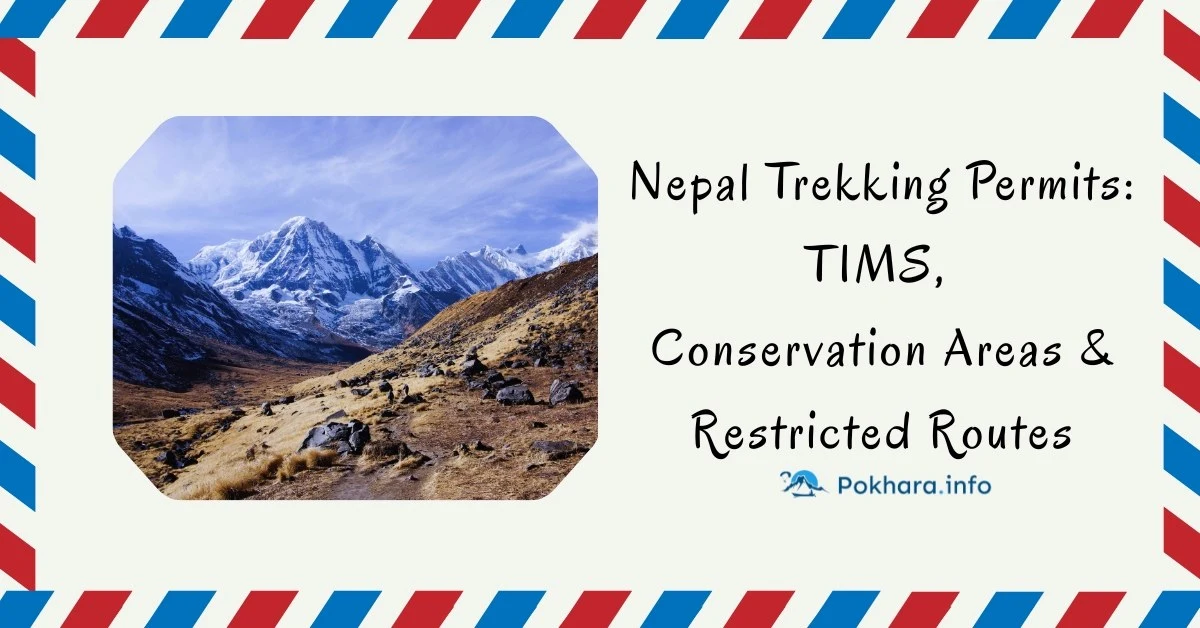
The permits required for trekking in Nepal depend on where you are trekking. A route may require a TIMS card, a national park or conservation-area entry permit, a restricted-area trekking permit, or a combination of these.
For many popular trekking regions, the current system also requires trekkers to travel with a licensed trekking guide and obtain TIMS through a government-registered trekking agency.
Nepal Tourism Board specifically lists routes in the Everest, Langtang, Manaslu, Annapurna, Mustang, Dolpo, and other regions under the current guide-and-TIMS provisions.
The important distinction is that TIMS is not the same thing as a conservation-area or national-park entry permit. A trekker may need more than one document for the same journey.
Before starting a trek, check the exact route rather than relying on a general statement that "Nepal requires one trekking permit."
The Main Types of Nepal Trekking Permits
Most trekkers will encounter three categories of requirements:
Requirement | What it is for | Examples |
TIMS | Trekker registration and route/safety management | Mardi Himal, Annapurna Circuit, Manaslu, Langtang and other listed routes |
Protected-area entry fee | Entry into a national park or conservation area | Annapurna, Manaslu, Sagarmatha, Langtang |
Restricted-area trekking permit | Government-controlled access to designated restricted regions | Upper Mustang, Manaslu restricted area, Tsum Valley, Upper Dolpa |
These requirements can overlap. For example, a trek in the Manaslu region may involve TIMS, Manaslu Conservation Area entry and a separate restricted-area permit, depending on the exact route.
TIMS Card Nepal: What Trekkers Need to Know
TIMS, or the Trekkers' Information Management System, records information about trekkers, their routes, and their trekking arrangements.
Under the Nepal Tourism Board's current TIMS information, the fee is:
NPR 2,000 per person for applicants from countries outside SAARC
NPR 1,000 per person for SAARC applicants
The current system states that the TIMS card for applicable routes is arranged through a government-registered trekking agency, with the agency submitting the trekker, guide, and route details. The resulting TIMS is issued electronically with a QR code.
This is particularly important for travelers reading older information online. Previous TIMS arrangements and fee structures have changed, so an old blog should not be treated as the current rule.
Which Treks Require TIMS and A Guide?
Nepal Tourism Board's current list includes routes such as:
Everest region
Everest Base Camp Trek
Gokyo Trek
Everest Three High Passes Trek
Other listed Khumbu routes
Langtang region
Langtang Trek
Tamang Heritage Trek
Ganja La and other listed routes
Manaslu region
Manaslu Circuit Trek
Manaslu-Tsum Valley Trek
Tsum Valley Trek
Annapurna region
Annapurna Circuit
Nar Phu-Annapurna Circuit
Tilicho/Mesokanto routes
Poon Hill-ABC
Khopra Trek
Mardi Himal
Other listed routes
The list also includes routes in Mustang, Dolpo, Humla, Dhaulagiri and other regions.
The practical rule is simple: check your exact trek against the current Nepal Tourism Board TIMS list before planning an independent trek.
Conservation Area and National Park Entry Permits
TIMS does not replace a protected-area entry permit. If your trekking route enters a national park or conservation area, you must pay the applicable entry fee.
Nepal Tourism Board's current published fee schedule lists the following foreigner entry fees for several major trekking areas:
Protected area | Foreign visitor entry fee |
Annapurna Conservation Area | NPR 3,000 |
Manaslu Conservation Area | NPR 3,000 |
Sagarmatha National Park | NPR 3,000 |
Langtang National Park | NPR 3,000 |
Shey-Phoksundo National Park | NPR 3,000 |
Makalu-Barun National Park | NPR 3,000 |
Kanchenjunga Conservation Area | NPR 2,000 |
Gaurishankar Conservation Area | NPR 3,000 |
The fees are listed per person per entry, and SAARC and Nepali rates are different.
Annapurna Permit
For travelers starting in Pokhara, the Annapurna Conservation Area Permit is particularly relevant.
The current Nepal Tourism Board protected-area fee schedule lists the Annapurna Conservation Area entry fee at NPR 3,000 for foreign visitors and NPR 1,000 for SAARC nationals.
This applies to trekking routes within the Annapurna Conservation Area, subject to the route's other requirements.
The Annapurna Conservation Area is one of the main trekking regions accessible from Pokhara, making this permit particularly important for routes such as Annapurna Base Camp, Mardi Himal, Ghorepani-Poon Hill and the Annapurna Circuit.
Restricted Area Trekking in Nepal
A restricted area is different from an ordinary conservation area or national park.
The Government of Nepal designates certain regions as restricted because of their geographical location, border sensitivity, environmental considerations or other regulatory reasons.
Trekkers entering these areas need a special trekking permit issued under the Department of Immigration's restricted-area system.
Nepal Tourism Board states that restricted-area permits must be obtained through the applicable official process and that trekkers must carry the permit while trekking and show it to immigration or police officials when requested.
The restricted-area permit is therefore not simply another name for a TIMS card.
Manaslu Permit: What Does the Manaslu Trek Require?
The Manaslu region is one of the clearest examples of why trekkers need to understand the difference between permits.
A typical Manaslu itinerary can involve:
TIMS
Manaslu Conservation Area entry
Restricted-area trekking permit for the applicable section
The Department of Immigration currently lists the restricted Manaslu area as Chumnubri Rural Municipality wards 1 to 4 in Gorkha. Its published permit rates are:
September to November: USD 100 per person per week, then USD 15 per day beyond one week
December to August: USD 75 per person per week, then USD 10 per day beyond one week
The Manaslu Conservation Area entry fee is separate. Nepal Tourism Board currently lists it at NPR 3,000 for foreign visitors and NPR 1,000 for SAARC nationals.
This means the phrase "Manaslu permit" can be ambiguous. A trekker may be referring to the restricted-area permit, the conservation-area entry fee, or the overall set of documents required for the trek.
Upper Mustang Trekking Permit
Upper Mustang is another major restricted-area trekking destination.
The current Department of Immigration fee is: USD 50 per person per day.
The restricted area covers designated parts of Lomanthang Rural Municipality, Lo-Ghekar Damodarkunda Rural Municipality and Baragung Muktichetra Rural Municipality.
The Upper Mustang restricted-area permit is separate from the Annapurna Conservation Area entry fee because Upper Mustang lies within the broader Annapurna conservation region.
This distinction is important when calculating the total cost of an Upper Mustang trek: paying the conservation-area entry fee does not eliminate the restricted-area permit.
Upper Dolpa Trekking Permit
Upper Dolpa has one of Nepal's more substantial restricted-area permit costs.
The current Department of Immigration schedule lists:
USD 500 per person for the first 10 days
USD 50 per person per day beyond 10 days
Upper Dolpa also involves the relevant protected-area entry requirements. Nepal Tourism Board currently lists the Shey-Phoksundo National Park entry fee at NPR 3,000 for foreign visitors.
Because of the permit cost and remote logistics, Upper Dolpa requires a very different budget from a short Annapurna or Langtang trek.
Tsum Valley Permit
Tsum Valley is another restricted area within the Manaslu region.
The Department of Immigration currently lists the Tsum Valley restricted-area fee as:
September to November: USD 40 per person per week, then USD 7 per day beyond one week
December to August: USD 30 per person per week, then USD 7 per day beyond one week
A Tsum Valley trek can therefore require both the restricted-area permit and the applicable conservation-area and TIMS requirements.
Other Restricted Trekking Areas
Nepal's restricted-area permit system covers more than Upper Mustang and Manaslu.
The current Department of Immigration schedule includes restricted areas in:
Mustang
Dolpa
Gorkha
Manang
Humla
Taplejung
Dolakha
Solukhumbu
Rasuwa
Sankhuwasabha
Bajhang
Mugu
Darchula
Other designated areas
Permit rates differ significantly by location and, in some cases, by season.
For example, the current schedule lists Narpa and Nasho areas of Manang at USD 100 per person per week during September to November and USD 75 per week during December to August, with additional daily charges after the first week.
This is why there is no single "restricted area permit price" for Nepal.
Nepal Trekking Permit Fees at a Glance
For planning purposes, the following examples show how different the permit structure can be:
Trek/area | Main additional permit or entry requirement | Current listed fee |
Annapurna | Conservation Area entry | NPR 3,000 for foreign visitors |
Mardi Himal | ACAP + TIMS where applicable | NPR 3,000 ACAP + NPR 2,000 TIMS for non-SAARC |
Manaslu Circuit | Manaslu Conservation Area + restricted-area permit + TIMS | Route/season dependent |
Upper Mustang | Restricted-area permit + applicable protected-area entry | USD 50/person/day for restricted permit |
Upper Dolpa | Shey-Phoksundo NP + restricted-area permit | USD 500/person/first 10 days for restricted permit |
Tsum Valley | Restricted-area permit + applicable protected-area requirements + TIMS | USD 30 to 40/person/week depending on season |
Everest Base Camp | Sagarmatha NP + TIMS where applicable | NPR 3,000 park entry + current TIMS requirement |
The fees above are based on current official information and should still be checked immediately before travel because government charges and procedures can change.
Do Short Treks from Pokhara Need Permits?
It depends on the trail.
This is particularly important for travelers searching for short treks from Pokhara, because not every hike around Pokhara falls under the same trekking regulations.
A route entering the Annapurna Conservation Area may require the applicable conservation-area entry fee. Routes such as Mardi Himal are also included in Nepal Tourism Board's current list of treks requiring a licensed guide and TIMS.
By contrast, a short local hike outside a regulated trekking route should not automatically be treated as if it were the Annapurna Circuit.
Before leaving Pokhara, establish:
Exact trailhead
Exact route
Whether it enters a protected area
Whether TIMS applies
Whether a licensed guide is mandatory
Whether a restricted-area permit is involved
The Nepal Tourism Board's Pokhara office and government-registered trekking agencies in Pokhara are useful places to confirm the current requirements before departure.
Where Can You Get Nepal Trekking Permits?
The issuing authority depends on the type of requirement.
TIMS
Under the current system, applicable TIMS cards are arranged through government-registered trekking agencies, which submit the trekker and route information and generate the electronic TIMS card.
National Park and Conservation-Area Entry Fees
Nepal Tourism Board's current information states that protected-area entry fees can be paid at designated tourist service locations or at applicable entry points.
Restricted-Area Permits
Restricted-area trekking permits are handled through the Department of Immigration under the restricted-area permit system.
For travelers already in Pokhara, the practical approach is to confirm the requirements with a registered trekking agency before departure rather than arriving at the trailhead without the required documentation.
What Documents Do You Need for a Trekking Permit?
Requirements vary by permit type, but trekkers should generally be prepared with:
Valid passport
Passport details
Passport-size photographs where required
Trek itinerary
Trekking agency and guide details where applicable
Emergency contact information
Applicable permit fees
For current TIMS processing, the trekking agency submits the required trekker, guide, and route information through the official system.
For restricted-area permits, additional itinerary and agency information may be required because these permits are controlled more strictly.
Do You Need a Separate Permit for Every Trek?
Not necessarily.
A single trek can involve several different documents, but they do not all represent separate trekking permits.
For example, an Annapurna trek may involve: TIMS + Annapurna Conservation Area entry fee
A Manaslu trek may involve: TIMS + Manaslu Conservation Area entry + restricted-area permit
An Upper Mustang itinerary may involve: TIMS where applicable + Annapurna Conservation Area entry + Upper Mustang restricted-area permit
The exact combination depends on the route.
This is why it is better to ask "What documents does my exact route require?" rather than simply asking whether Nepal has a trekking permit.
Do Children Need Trekking Permits?
Protected-area entry rules can provide child exemptions. Nepal Tourism Board's current protected-area fee table states that children below 10 years are free for the listed national parks and conservation areas.
Restricted-area permits and other trekking requirements should be checked separately because the rules for special trekking permits are not necessarily identical to protected-area entrance fees.
Families should therefore confirm the requirements for every member of the group before departure.
How Long Are Nepal Trekking Permits Valid?
Validity depends on the type of permit.
Protected-area entry fees are generally described as per person per entry, while restricted-area permits can be calculated by day or week, depending on the region.
A restricted-area permit also specifies where the trekker is permitted to travel. Nepal Tourism Board states that trekking outside the specified area or route is considered a violation, and trekkers must carry the permit during the trek.
Do not assume that extending or changing your itinerary is automatically covered by an existing permit.
What Happens If You Trek Without the Required Permit?
Trekking in a protected or restricted area without the required authorization can create serious problems.
Restricted-area rules specifically state that the permit must be carried while trekking and shown to immigration or police officials upon request. Nepal Tourism Board also states that trekking outside the permitted route is considered a violation.
Beyond the regulatory issue, missing documentation can cause problems at checkpoints or when trying to continue along a restricted route.
The safest approach is to obtain and verify all required documents before entering the regulated section of the trail.
TIMS vs Trekking Permit: What Is the Difference?
This is one of the most common sources of confusion.
TIMS is a trekker information and management system. It records details about the trekker, guide, and route for applicable trekking routes.
A conservation-area or national-park entry permit/fee gives access to a protected area.
A restricted-area trekking permit provides authorization to enter and trek within a designated restricted region.
They serve different purposes.
Document | Main purpose |
TIMS | Trekker registration and route/safety management |
Conservation-area entry | Access to a designated conservation area |
National-park entry | Access to a national park |
Restricted-area permit | Authorization to trek in a designated restricted area |
A route can require more than one of them.
What Should Trekkers Check Before Leaving Pokhara?
If you are starting an Annapurna trek from Pokhara, do not limit your preparation to accommodation and transportation.
Before departure, verify:
The exact route: A trek's name alone may not identify every regulated section.
TIMS requirement: Check the current Nepal Tourism Board list.
Protected-area entry fee: Confirm whether your route enters Annapurna Conservation Area or another protected area.
Guide requirement: Some routes currently require a licensed guide as part of the TIMS provisions.
Restricted-area permit: If your itinerary enters areas such as Upper Mustang, Manaslu restricted areas or Tsum Valley, check the Department of Immigration schedule.
Current fees: Government fees can change, so use current official schedules rather than an old trekking blog.
Conclusion
Understanding Nepal trekking permits is an important part of planning a trek because there is no single permit that covers every route in the country.
For many popular treks, TIMS and a protected-area entry fee are the main requirements. Routes entering restricted regions add another layer, with special permits administered under the Department of Immigration. Manaslu, Upper Mustang, Upper Dolpa and Tsum Valley are good examples of routes where the permit structure is more complex.
For travelers beginning in Pokhara, the first question should be whether the planned route enters the Annapurna Conservation Area and whether it appears on the current TIMS and mandatory-guide list. For remote or restricted routes, check the Department of Immigration's current fee schedule as well.
Most importantly, do not rely on an old permit fee, an outdated TIMS rule, or another trekker's previous experience. Nepal's trekking regulations and fees can change. Checking the current Nepal Tourism Board and Department of Immigration information before departure is the most reliable way to make sure your documents, guide arrangements, and budget are correct.
Frequently Asked Questions About Nepal Trekking Permits
What permits do I need to trek in Nepal?
It depends on the route. You may need TIMS, a national-park or conservation-area entry fee, a restricted-area permit, or a combination of these. Current TIMS and route requirements should be checked with the Nepal Tourism Board before departure.
How much does a TIMS card cost in Nepal?
The current Nepal Tourism Board TIMS information lists NPR 2,000 for applicants from non-SAARC countries and NPR 1,000 for SAARC applicants on applicable routes.
How much is the Annapurna permit?
The current Annapurna Conservation Area entry fee listed by the Nepal Tourism Board is NPR 3,000 for foreign visitors and NPR 1,000 for SAARC nationals, per person per entry.
Is a guide mandatory for trekking in Nepal?
Not every walk in Nepal should be treated the same, but many major trekking routes are currently subject to mandatory licensed-guide and TIMS requirements. Nepal Tourism Board's current list includes routes such as Annapurna Circuit, Mardi Himal, Manaslu Circuit, Langtang, and Everest-region treks.
How much is the Manaslu restricted-area permit?
For the restricted Manaslu area, the current Department of Immigration rate is USD 100 per person per week from September to November and USD 75 per person per week from December to August, with additional daily charges after the first week. This is separate from the Manaslu Conservation Area entry fee.
Do I need a permit for a trek from Pokhara?
It depends on the route. Treks entering the Annapurna Conservation Area require the applicable entry fee, and routes such as Mardi Himal are currently included in Nepal Tourism Board's TIMS and guide requirements. A short local hike outside a regulated trekking route can have different requirements.