Starting Point: Pokhara
Trailhead: Bijayapur/Kalika area
Ending Point: Begnas Lake, followed by drive to Pokhara
Duration: 4 to 5 Days
Trek Grade: Easy
Highest Point: Approximately 1,730 m at Syaklung
Approx. Trekking Distance: Around 35 to 45 km, depending on the route
Accommodation: Tea houses, lodges and homestays
Best Seasons: Spring and autumn
ACAP: Required
TIMS: Check current requirement before departure
Guide: Arrange a licensed guide where required under current regulations
Transportation: Private vehicle, taxi or local transport
Region: Annapurna Conservation Area
The Royal Trek is one of Nepal's shorter and easier trekking routes. Located east of Pokhara, it follows a low-altitude ridge through terraced farmland, forest and traditional villages before descending toward Begnas Lake.
Unlike high-altitude treks such as Annapurna Base Camp or the Annapurna Circuit, the Royal Trek stays below 2,000 m. Its appeal is therefore less about extreme altitude and more about mountain scenery, village life, Gurung culture and a relaxed walking experience.
The classic route reaches approximately 1,730 m at Syaklung, making it suitable for travelers who want a Himalayan trekking experience without the acclimatization requirements of high mountain routes.
What Is the Royal Trek?
The Royal Trek is a short trekking route in the foothills of the Annapurna region, just east of Pokhara.
The trail passes through rural settlements, cultivated hillsides and forested ridges, with views toward the Annapurna range, Lamjung Himal and Machhapuchhre on clear days.
The route is particularly popular among first-time trekkers, families and travelers with limited time in Nepal. Walking days are generally moderate in length, and the trail does not involve high mountain passes or technical climbing.
A typical itinerary follows:
Pokhara to Bijayapur to Kalikasthan to Syaklung to Chisapani to Begnas Lake to Pokhara
There are several variations, so the exact overnight stops and walking distance can differ between itineraries.
Why Is It Called the Royal Trek?
The trek received its name after Britain's Prince Charles visited the area in 1980 and trekked through the villages around Kalikasthan and Syaklung before descending toward the lakes east of Pokhara.
Nepal Tourism Board describes the route as one that Prince Charles explored while visiting Gurkha recruits' homes. The trail subsequently became known as the Royal Trek.
Today, the historic connection is only part of its appeal. The route offers a relatively quiet way to experience the countryside surrounding Pokhara without undertaking a long or high-altitude expedition.
Royal Trek Route
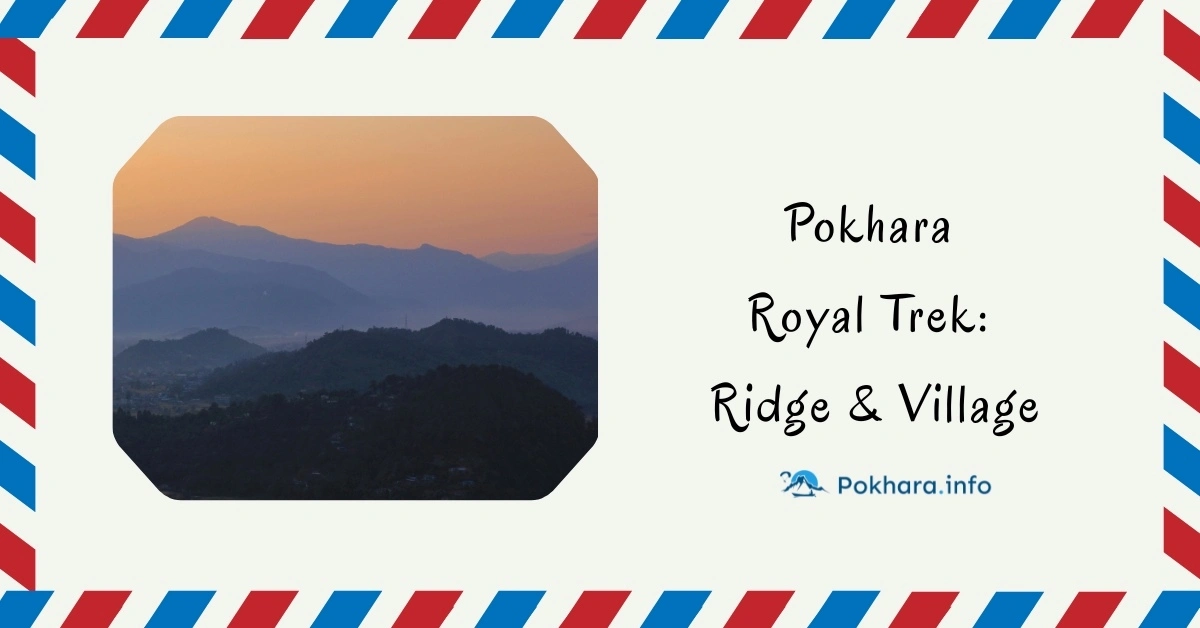
The Royal Trek is essentially a ridge-and-village trek.
After a short drive from Pokhara to the trailhead around Bijayapur, the walking route climbs gradually toward Kalikasthan. From there, it continues along the ridge toward Syaklung before descending through forest and villages to Chisapani.
The final walking section takes trekkers toward Begnas Lake, from where road transportation returns them to Pokhara.
Main Stops Along the Route
Pokhara: The starting and finishing city, known for Phewa Lake and views toward the Annapurna region.
Bijayapur: The road-accessible starting area for the walking portion of the classic route.
Kalikasthan: The first major overnight settlement, situated at approximately 1,370 m.
Syaklung: The highest major point of the classic trek at approximately 1,730 m and one of the best mountain viewpoints.
Chisapani: A hillside settlement at around 1,550 m, offering views of the surrounding mountains and valleys.
Begnas Lake: The traditional endpoint of the walking route before returning to Pokhara by road.
Highlights of the Pokhara to Royal Trek
Low-Altitude Himalayan Views
The Royal Trek does not take you deep into the high Himalayas, but its ridge-top sections provide impressive views of the Annapurna region. On clear days, you may see peaks including Annapurna II, Annapurna IV, Lamjung Himal and Machhapuchhre, depending on the section and weather.
Syaklung Ridge
Syaklung, at approximately 1,730 m, is the highest point on the classic route. The ridge around the village is one of the trek's best locations for looking toward the surrounding mountains and valleys.
Gurung Village Life
The trek passes through traditional settlements where agriculture and village life remain central to the local economy. Staying in local accommodation provides opportunities to experience rural hospitality rather than simply walking through the villages.
Terraced Farmland
The lower and middle sections of the trek pass through hillside terraces used for crops such as rice, millet and other seasonal produce. These cultivated landscapes create a distinctive contrast with the forested ridges and distant snow peaks.
Rhododendron and Forest Trails
Parts of the route pass through mixed forest, including rhododendron and other Himalayan vegetation. Spring can be particularly attractive when rhododendrons are flowering.
Begnas Lake
Finishing the trek at Begnas Lake provides a relaxing contrast to the walking days. After descending from the hills, trekkers can spend some time around the lake before taking road transportation back to Pokhara.
Royal Trek Difficulty
The Royal Trek is considered an easy trek by Nepal's trekking standards.
It does not involve technical climbing, high passes or prolonged exposure to extreme altitude. Most of the challenge comes from ordinary uphill and downhill walking rather than altitude.
Terrain
The route includes:
Village paths
Dirt trails
Forest tracks
Terraced farmland
Ridge walking
Uphill and downhill sections
Occasional uneven or stone-paved sections
The trail is not completely flat, so trekkers still need reasonable walking fitness.
Walking Hours
Most days involve approximately 4 to 6 hours of walking, depending on the itinerary, trail condition and pace. Current itineraries commonly list four to six hours for the principal stages.
Who Can Do the Royal Trek?
The route is suitable for:
First-time trekkers
Families with reasonably fit older children
Older travelers who are comfortable walking several hours
Travelers with limited time
People who want a low-altitude Himalayan experience
You do not need previous high-altitude trekking experience.
Altitude and Altitude Sickness
One of the biggest advantages of the Royal Trek is its low elevation.
The highest point of the classic route is around 1,730 m at Syaklung. Because the trek remains well below the elevations reached by Nepal's major high-altitude routes, acclimatization is generally not a major concern.
However, saying that altitude sickness is impossible would be inaccurate. Individual responses to elevation vary, and anyone feeling unwell should take symptoms seriously.
For most trekkers, ordinary hydration, adequate rest and a sensible walking pace are sufficient.
Royal Trek Permits
The Royal Trek passes through the Annapurna Conservation Area, so an Annapurna Conservation Area Permit (ACAP) is required.
ACAP Fee
The current NTNC entry fee is:
Foreign nationals: NPR 3,000
SAARC nationals: NPR 1,000
The fee includes applicable tax. Permits can be obtained through NTNC's online system or at authorized entry-permit counters, including the Pokhara counter.
TIMS Card
TIMS requirements have changed over time and can vary according to the applicable trekking route and whether you are traveling independently or through a registered agency.
For that reason, trekkers should confirm the current TIMS requirement before departure rather than relying on older Royal Trek articles.
If you book through a registered trekking agency, the agency can normally arrange the applicable trekking documentation for you.
5-Day Pokhara to Royal Trek Itinerary
A five-day itinerary gives travelers a comfortable pace while allowing time to experience the villages rather than rushing through the route.
Day 1: Pokhara to Bijayapur and Trek to Kalikasthan
The trek begins with a short drive from Pokhara toward Bijayapur, where the walking portion starts.
The trail initially passes through cultivated land and rural settlements before gradually climbing toward Kalikasthan. The landscape changes quickly from the urban environment of Pokhara to farmland, village paths and forested hills.
After approximately four to five hours of walking, reach Kalikasthan at around 1,370 m.
Overnight: Kalikasthan
Altitude: Approximately 1,370 m
Walking: About 4 to 5 hours
Day 2: Kalikasthan to Syaklung
Day two follows the ridge toward Syaklung.
The trail passes through farmland, small settlements and forested sections. As you continue along the ridge, the surrounding landscape opens up and mountain views become more prominent.
Syaklung sits at approximately 1,730 m, making it the highest point of the classic Royal Trek. This is one of the most scenic sections of the route, particularly when the weather is clear.
Overnight: Syaklung
Altitude: Approximately 1,730 m
Walking: About 5 to 6 hours
The combination of ridge walking, Gurung villages and mountain views makes this the defining day of the trek.
Day 3: Syaklung to Chisapani
The trail gradually descends from Syaklung toward Chisapani. The route passes through forest and cultivated land, with occasional uphill sections breaking up the descent.
Chisapani is situated at approximately 1,550 m and provides another opportunity to experience local village life. Depending on the exact route and accommodation arrangement, walking generally takes around five hours.
Overnight: Chisapani
Altitude: Approximately 1,550 m
Walking: About 4 to 6 hours
Day 4: Chisapani to Begnas Lake
The final major walking day takes you downhill toward Begnas Lake.
The route gradually leaves the higher ridge environment and enters lower forest and agricultural areas. The descent can be more tiring on the knees than the earlier uphill sections, so trekking poles can be useful.
After reaching Begnas Lake, you can relax beside the water or explore the lakeside area. Depending on your itinerary, you can either stay around Begnas or return to Pokhara by road the same day.
Walking: Approximately 4 to 6 hours
Destination: Begnas Lake
Several current itineraries use Begnas Lake as the endpoint of the walking route before a short drive back to Pokhara.
Day 5: Begnas Lake to Pokhara / Buffer Day
For travelers choosing a five-day itinerary, the fifth day can be used as a relaxed return day or as a buffer. If you returned to Pokhara on Day 4, use Day 5 to rest, explore Lakeside or continue with another Pokhara activity.
Alternatively, you can spend more time around Begnas Lake before returning to Pokhara. This flexible final day is one reason the Royal Trek works well for travelers who do not want a tightly packed itinerary.
Can the Royal Trek Be Done in 4 Days?
Yes.
A four-day itinerary is arguably the most straightforward version of the classic route:
Day 1: Pokhara to Bijayapur to Kalikasthan
Day 2: Kalikasthan to Syaklung
Day 3: Syaklung to Chisapani
Day 4: Chisapani to Begnas Lake to Pokhara
Best Time for the Royal Trek
The Royal Trek can be completed during several months of the year because it remains at relatively low altitude. However, spring and autumn are the best overall seasons for comfortable walking and mountain views.
Spring: March to May
Spring brings mild temperatures and flowering vegetation. March and April are particularly attractive for forest scenery, while May can become warmer at lower elevations.
Autumn: September to November
Autumn generally provides some of the clearest mountain views after the monsoon. October and November are particularly good choices for trekkers who prioritize Himalayan visibility.
Winter: December to February
Winter is possible because the Royal Trek does not reach extreme elevations. Mornings and nights can be cold, but the lower altitude makes the route considerably more accessible than high Himalayan treks.
Monsoon: June to August
The route can be trekked during the monsoon, but heavy rainfall can make trails muddy and slippery. Rain can also obscure mountain views and make road transportation less predictable.
For the best combination of trail conditions and scenery, spring and autumn remain the safer choices.
Accommodation on the Royal Trek
Accommodation is simple and locally operated.
Depending on the itinerary, trekkers can stay in:
Tea houses
Small local lodges
Community homestays
Rooms are generally basic, with beds and mattresses, while bathrooms may be shared. Do not expect the range of facilities available in Pokhara or on heavily commercialized trekking routes.
The simplicity is part of the Royal Trek experience. Staying in villages gives trekkers a closer connection to local communities and provides an opportunity to experience traditional hospitality.
Food and Water
Meals along the Royal Trek are generally simple but sufficient for short trekking days.
Common options include:
Dal bhat
Rice and vegetables
Noodles
Momos
Eggs
Soup
Pasta
Tea
Coffee
Dal bhat is particularly useful for trekkers because it provides a filling combination of carbohydrates, vegetables and protein. Carry a reusable water bottle and use treated, filtered or otherwise safe drinking water.
Royal Trek Cost
The cost of the Royal Trek depends on whether you join a group, book a private trek, travel independently or choose a package that includes a guide, meals, accommodation and transportation.
For practical planning, a 4 to 5 day guided Royal Trek generally falls around US$300 to $550 per person.
Current advertised prices show considerable variation. One 2026 five-day operator listing ranges from US$320 to $400 per person depending on group size, while another current guide estimates roughly US$250 to $450 for a guided four-day trek. Private and more comprehensive packages can reach US$500 to $550 or more.
Practical Royal Trek Budget
Trek Style | Approx. Cost per Person |
Budget/group trek | US$300 to $400 |
Standard guided trek | US$400 to $500 |
Private/smaller-group trek | US$500 to $550+ |
These are planning ranges rather than fixed prices.
What May Be Included
A standard package may include:
Licensed trekking guide
Accommodation
Meals during the trek
Transportation to the trailhead
Transportation from Begnas Lake
ACAP permit
Applicable TIMS fees
Guide's food and accommodation
What May Cost Extra
Budget separately for:
Personal drinks and snacks
Travel insurance
Trekking equipment
Tips
Hot showers
Wi-Fi
Charging
Emergency evacuation
Personal expenses
For a straightforward guided trip, US$400 to $500 per person is a useful working budget for planning purposes, while travelers seeking a private arrangement should allow more.
Is a Guide Necessary for the Royal Trek?
A guide is strongly recommended, particularly for international travelers.
Although the Royal Trek is easy compared with high-altitude Himalayan routes, a guide can still help with:
Route navigation
Accommodation
Local communication
Permit arrangements
Cultural interpretation
Weather decisions
Emergency assistance
Because trekking regulations and TIMS requirements can change, booking through a registered trekking agency can also simplify the administrative side of the trip.
Is the Royal Trek Suitable for Beginners?
Yes.
The Royal Trek is one of the better choices for travelers attempting their first multi-day trek in Nepal. Its low maximum altitude, relatively short walking days and absence of technical terrain make it considerably less demanding than high-altitude routes.
However, beginners should still prepare for several consecutive days of walking. Regular walking, stair climbing and weekend hikes before the trip are enough for most reasonably fit travelers.
What to Pack for the Royal Trek
Because this is a low-altitude trek, you do not need the same extreme cold-weather equipment required for Everest Base Camp or high passes.
Clothing
Moisture-wicking T-shirts
Long-sleeve shirts
Lightweight fleece
Light down or insulated jacket
Waterproof jacket
Trekking trousers
Lightweight thermal layer
Sun hat
Warm hat
Light gloves
Hiking socks
Rain protection
Footwear
Comfortable hiking shoes or boots
Spare hiking socks
Lightweight sandals or camp shoes
Good grip is important because trails can become slippery after rain.
Trekking Equipment
Daypack
Trekking poles
Reusable water bottle
Water purification method
Headlamp
Sunglasses
Sunscreen
Power bank
Small first-aid kit
Personal medication
Toiletries
Toothbrush and toothpaste
Biodegradable soap
Hand sanitizer
Toilet paper
Quick-dry towel
Basic personal toiletries
You should pack light. The Royal Trek does not require expedition-level equipment.
Money and Connectivity
Carry enough Nepali rupees in cash for the trek. Do not depend on ATMs or card payments in the villages along the trail. Facilities are much more limited than in Pokhara.
Mobile connectivity can also vary between settlements and terrain. If staying in a local homestay or tea house, do not assume that Wi-Fi or reliable charging will always be available.
Responsible Trekking on the Royal Trek
The Royal Trek passes through working rural communities, so responsible tourism is particularly important.
Follow These Practices
Carry reusable water bottles.
Avoid unnecessary plastic.
Take your rubbish with you.
Stay on established trails.
Ask permission before photographing residents.
Respect homes and religious sites.
Buy local food and services where possible.
Avoid wasting water.
Respect local customs and dress appropriately.
The Royal Trek's appeal comes partly from its village character. Preserving that character benefits both local communities and future trekkers.
Royal Trek vs. Other Short Treks from Pokhara
The Royal Trek is particularly suitable if your priority is easy trekking and cultural immersion rather than altitude.
Trek | Approx. Highest Point | Difficulty | Best For |
Royal Trek | 1,730 m | Easy | Beginners, families, short trips |
Panchase Trek | ~2,500 m | Easy to Moderate | Village scenery and mountain views |
Ghorepani Poon Hill | ~3,210 m | Moderate | Sunrise and higher mountain views |
Mardi Himal | ~4,500 m+ | Moderate | High-altitude mountain scenery |
Annapurna Base Camp | ~4,130 m | Moderate to Difficult | Classic Himalayan experience |
If you want the easiest multi-day option, the Royal Trek is one of the strongest choices.
Conclusion
The Pokhara to Royal Trek is one of Nepal's best options for travelers who want a genuine multi-day trekking experience without the physical demands of a high-altitude Himalayan route.
Its historic connection to Prince Charles gives the trail its distinctive name, but the real attraction is the journey itself: terraced farmland, forested ridges, Gurung villages, mountain viewpoints and the peaceful setting of Begnas Lake.
With a maximum elevation of only around 1,730 m, the Royal Trek avoids the acclimatization challenges associated with Nepal's higher routes while still providing memorable views of the Annapurna region.
A 4-day itinerary works well for travelers with limited time, while a 5-day version allows a more relaxed pace. For most trekkers, spring and autumn provide the best combination of weather and mountain visibility.
If your goal is to experience the culture and landscapes of the Annapurna foothills without committing to a demanding high-altitude trek, the Royal Trek is an excellent place to start.
Frequently Asked Questions
How long is the Royal Trek?
The classic Royal Trek generally takes 4 to 5 days from Pokhara and back, although longer versions can be created by adding additional village nights.
What is the highest point of the Royal Trek?
The highest point of the classic route is approximately 1,730 m at Syaklung.
Is the Royal Trek difficult?
No. It is considered an easy trek, although you still need enough fitness to walk for approximately four to six hours on several consecutive days.
Is the Royal Trek suitable for beginners?
Yes. Its low elevation, manageable terrain and relatively short duration make it a strong choice for first-time trekkers.
Is altitude sickness a problem on the Royal Trek?
The risk is very low because the route remains below 2,000 m. The highest point is around 1,730 m, so the acclimatization concerns associated with high-altitude treks generally do not apply.
Where does the Royal Trek start?
The walking portion traditionally starts around Bijayapur, a short drive from Pokhara.
Where does the Royal Trek end?
The classic route finishes around Begnas Lake, after which trekkers return to Pokhara by road.
Do I need an ACAP permit?
Yes. The Royal Trek lies within the Annapurna Conservation Area, so an ACAP entry permit is required. The current fee is NPR 3,000 for foreign nationals and NPR 1,000 for SAARC nationals.
Do I need a TIMS card?
TIMS requirements can change according to Nepal's current trekking regulations and the way the trek is organized. Confirm the requirement before departure, particularly if traveling independently.
How much does the Royal Trek cost?
A realistic planning range is US$300 to $550 per person for a 4 to 5 day guided trek. Group size, guide services, meals, accommodation and transportation significantly affect the final price.
What is the best season for the Royal Trek?
Spring (March to May) and autumn (September to November) are the best overall seasons. October and November are particularly good for clear mountain views.
Can I do the Royal Trek in winter?
Yes. Because the route remains at low altitude, winter trekking is possible. You should still prepare for cold mornings and nights.
Can I do the Royal Trek during monsoon?
Yes, but it is less predictable. Rain can make trails muddy and slippery and can reduce mountain visibility. Spring and autumn are preferable.
Is accommodation available along the Royal Trek?
Yes. Basic tea houses, lodges and homestays are available along the commonly used route. Facilities are simple compared with those in Pokhara.
Can I return to Pokhara on the final trekking day?
Yes. Most itineraries descend toward Begnas Lake and use road transportation to return to Pokhara on the same day.
Is the Royal Trek the same as the Annapurna Circuit?
No. The Royal Trek is a short, low-altitude route near Pokhara, while the Annapurna Circuit is a much longer high-altitude trek that crosses the Thorong La region.
Why should I choose the Royal Trek?
Choose the Royal Trek if you want a short, easy Himalayan trek with village culture and mountain views without spending several days at high altitude.