Starting Point: Pokhara
Ending Point: Pokhara
Duration: 6 Days / 5 Nights
Trek Grade: Moderate
Highest Point: Around 3,700 m at Korchan Danda
Main Viewpoints: Khumai Danda and Korchan Danda
Accommodation: Local tea houses, lodges and homestays
Best Seasons: Spring and autumn
Required Permit: ACAP Entry Permit
TIMS: Required under current trekking regulations
Guide: Licensed trekking guide required where current TIMS rules apply
Starting Transport: Road journey from Pokhara
Region: Annapurna Conservation Area
The Machhapuchhre Model Trail is a relatively less-developed trekking route in the Annapurna region of Nepal. One of its most attractive features is its proximity to Pokhara: trekkers can leave the city and reach rural villages and forest trails without spending several days on approach roads.
The route described here follows the Ghachok to Hile Kharka to Khumai Danda to Korchan to Mirsha to Ghachok section, a commonly used version of the Machhapuchhre Model Trek. Current itineraries from trekking operators place Hile Kharka at around 2,160 m, Khumai Danda at 3,245 m and Korchan Danda at approximately 3,700 m.
What Is the Machhapuchhre Model Trail?
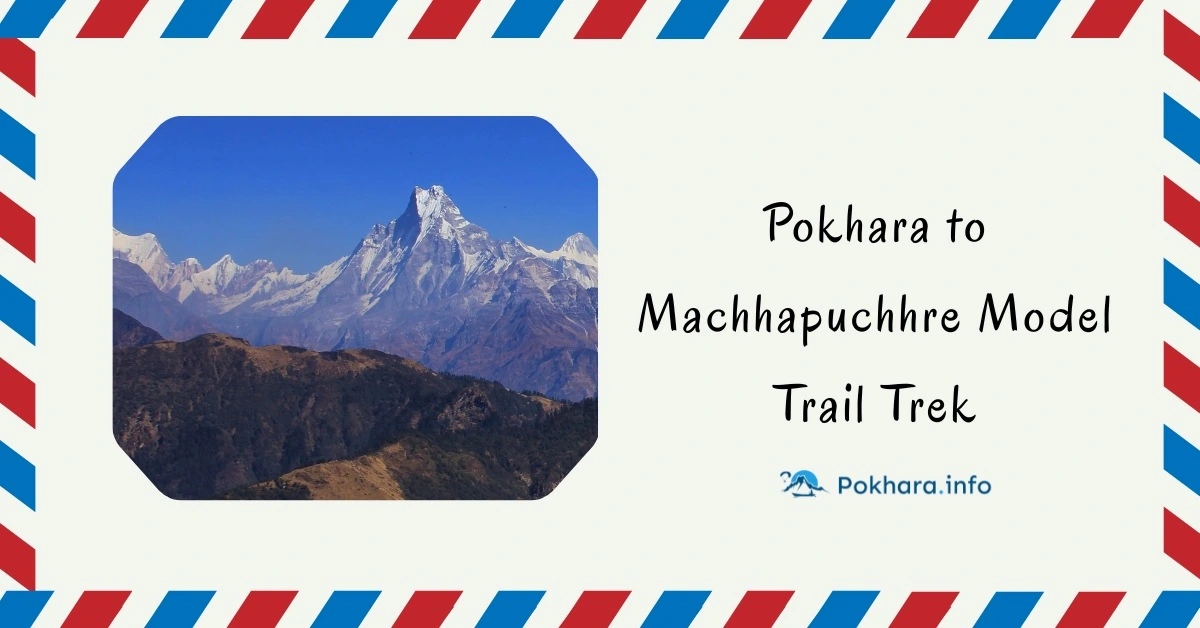
The Machhapuchhre Model Trail is a trekking route in Kaski District that takes travelers into the quieter northern hills of Pokhara and toward the foothills of Machhapuchhre, better known as Fishtail Mountain.
Unlike the heavily established trekking routes deeper inside the Annapurna region, this trail combines relatively short access from Pokhara with rural settlements, forests, mountain viewpoints and community-based accommodation.
The trail is particularly appealing to trekkers who want impressive Himalayan scenery without committing to a two-week circuit or a long approach trek.
The route also passes through the Annapurna Conservation Area. The National Trust for Nature Conservation's current permit system specifically lists the Machhapuchhre Model Trek among the routes requiring an ACAP entry permit.
Why Trek the Machhapuchhre Model Trail?
The main attraction is the combination of accessibility and scenery.
From Pokhara, the landscape changes quickly. Roads and urban development give way to terraced farmland, traditional villages and forested hills. As the trail climbs toward Khumai Danda, the mountains become increasingly prominent.
Close Views of Machhapuchhre
Machhapuchhre dominates much of the route. The distinctive double summit of Fishtail is one of the most recognizable mountains in Nepal, and the higher viewpoints around Khumai and Korchan provide particularly impressive perspectives.
Khumai Danda
At approximately 3,245 m, Khumai Danda is one of the principal overnight destinations on this route. The open ridge provides expansive views toward Machhapuchhre and surrounding Annapurna peaks.
Korchan Danda
Korchan Danda is the high point of the commonly followed Khumai to Korchan section, at roughly 3,700 m. Trekkers generally make an early start to reach the viewpoint around sunrise.
From here, the panorama can include Machhapuchhre, Annapurna South, Hiunchuli, Mardi Himal and other surrounding peaks, depending on weather and visibility.
Rural Villages and Local Hospitality
The trail passes through communities where tourism infrastructure remains comparatively simple. Staying in local lodges or homestays gives trekkers a closer look at rural life than they would experience in the larger trekking hubs.
Forests and Changing Landscapes
Lower sections pass through cultivated hills and forest, while higher sections become more open and alpine. Rhododendron and other Himalayan vegetation are particularly noticeable during spring.
Pokhara to Machhapuchhre Model Trail Route
The exact route can vary because the Machhapuchhre Model Trail is not a single fixed itinerary. Several versions and circuits are used.
For a practical six-day trek, the route can be organized as:
[Pokhara] to [Ghachok] to [Hile Kharka] to [Khumai Danda] to [Korchan Danda] to [Khumai Danda] to [Mirsha] to [Ghachok] to [Pokhara]
The first section takes trekkers from Pokhara toward Ghachok by road before walking into the hills. From Hile Kharka, the route climbs toward Khumai Danda. The following day is dedicated to the high viewpoint around Korchan before descending toward lower settlements.
This version provides a good balance between trekking, mountain views and time in local communities without making the itinerary unnecessarily long. Several current itineraries follow essentially this sequence.
6-Day Pokhara to Machhapuchhre Model Trail Trek Itinerary
Day 1: Pokhara to Ghachok and Trek to Hile Kharka
The trek begins with a road journey from Pokhara toward Ghachok. The drive takes you away from the lakeside city and into the rural hills.
Ghachok sits at a lower elevation than the overnight destination, so the walking section involves a steady climb. The trail passes through cultivated land, villages and forest before reaching Hile Kharka at approximately 2,160 m.
The walking section generally takes around four hours, although the actual time depends on the route, trail conditions and walking pace. Current itineraries commonly use Ghachok as the roadhead and Hile Kharka as the first overnight stop.
Overnight: Hile Kharka
Approximate altitude: 2,160 m
Walking: About 4 to 5 hours
Day 2: Hile Kharka to Khumai Danda
The second day is more demanding because the trail gains considerable elevation.
You walk through forested terrain toward higher ridges, with the landscape gradually changing as you leave the lower settlements behind. The ascent becomes more noticeable as you approach Khumai Danda.
Khumai Danda sits at approximately 3,245 m and is one of the main highlights of the trek. The open surroundings provide excellent views toward Machhapuchhre and the Annapurna range.
The ascent should be taken at a comfortable pace. There is no advantage in rushing this section because the altitude increases considerably compared with the previous day.
Overnight: Khumai Danda
Approximate altitude: 3,245 m
Walking: About 5 to 6 hours
Current route descriptions consistently identify Khumai Danda at around 3,245 m and describe this section as a significant uphill day.
Day 3: Khumai Danda to Korchan Danda and Back
Day three is the main viewpoint day.
The trek begins early, usually before sunrise, because Korchan Danda is particularly attractive in the morning. The climb from Khumai Danda leads to the higher Korchan viewpoint at approximately 3,700 m.
As the sun rises, the surrounding peaks gradually become illuminated. On a clear day, the panorama can include Machhapuchhre, Annapurna South, Hiunchuli and Mardi Himal.
After spending time at the viewpoint, descend back toward Khumai Danda.
This is an important point about the itinerary: Korchan Danda is a viewpoint, not Machhapuchhre Base Camp. Reaching Korchan does not mean that you have completed a Machhapuchhre Base Camp trek.
The ascent to Korchan and return can make this a long day, so an early start is important. Current itineraries describe the Korchan viewpoint at roughly 3,682 to 3,700 m.
Overnight: Khumai Danda
Highest point: Approximately 3,700 m
Main activity: Sunrise/viewpoint excursion
Day 4: Khumai Danda to Mirsha Village
After leaving Khumai Danda, the trail descends significantly toward Mirsha Village.
The change in elevation is noticeable. The landscape gradually becomes greener and more settled as you lose altitude.
Mirsha is a Gurung village where accommodation is generally more local and basic than the facilities found in Pokhara or established trekking destinations.
This is an excellent opportunity to experience the cultural side of the trek. Rather than simply passing through the village, staying overnight allows you to interact with local hosts and experience rural hospitality.
Overnight: Mirsha Village
Approximate altitude: Around 1,400 to 1,500 m
Walking: Several hours of descent
Current itineraries use Mirsha as the overnight stop after the Khumai to Korchan section.
Day 5: Mirsha to Ghachok
The trail continues downhill from Mirsha toward Ghachok.
Depending on the exact route being used, trekkers may pass through areas associated with Tatopani or Kharpani hot springs. These natural hot springs are an optional attraction rather than the defining destination of the trek.
The day is considerably lower in altitude than the previous two days, making it a pleasant transition from the high ridges back toward the road-accessible villages.
Overnight: Ghachok
Walking: Several hours
Day 6: Ghachok to Pokhara
The final day is relatively straightforward.
After breakfast, leave Ghachok by road and return to Pokhara. Depending on transportation arrangements and road conditions, the journey can be completed by private vehicle, taxi or local transport.
Once you arrive in Pokhara, the trek is officially complete.
You can use the rest of the day to relax around Phewa Lake, explore Lakeside or continue with another activity in the Pokhara Valley.
How Difficult Is the Machhapuchhre Model Trail Trek?
The Machhapuchhre Model Trail is generally considered a moderate trek.
It does not require technical climbing, but it should not be described as an easy walk either. The difficulty comes mainly from elevation gain, steep sections, uneven mountain trails and the climb toward Khumai Danda and Korchan Danda.
The most demanding part is the transition from Hile Kharka to Khumai Danda, followed by the early-morning climb toward Korchan.
Fitness Required
You do not need to be an experienced Himalayan mountaineer. However, you should be comfortable walking uphill for several hours.
A few weeks of preparation involving:
Regular walking or hiking
Stair climbing
Cardiovascular exercise
Leg and core strengthening
Longer weekend hikes
can make the trek considerably easier.
If you rarely exercise or have little hiking experience, allow yourself more time and avoid treating the trek as a race.
Altitude on the Machhapuchhre Model Trail
Altitude is an important consideration because the route rises from Pokhara to approximately 3,700 m at Korchan Danda.
The overnight elevation at Khumai Danda is around 3,245 m, meaning the body is already exposed to significantly higher elevation by the second night.
Altitude sickness can affect trekkers regardless of age or fitness level. Nepal Tourism Board advises trekkers to understand Acute Mountain Sickness (AMS), particularly above 3,000 m.
Common Symptoms of Altitude Sickness
Watch for:
Headache
Nausea
Dizziness
Unusual fatigue
Loss of appetite
Difficulty sleeping
Do not continue ascending if symptoms are becoming worse. Tell your guide or trekking companions and descend if necessary.
The safest approach is to ascend gradually, stay hydrated, eat properly and give your body time to adjust.
Permits for the Machhapuchhre Model Trail Trek
The Machhapuchhre Model Trail lies within the Annapurna Conservation Area, so trekkers need the Annapurna Conservation Area Permit (ACAP). The NTNC's current online permit system specifically lists Machhapuchhre Model Trek under ACAP routes.
Annapurna Conservation Area Permit
The current ACAP entry fee listed by the National Trust for Nature Conservation is:
Foreign nationals: NPR 3,000
SAARC nationals: NPR 1,000
The permit can be obtained online or through an authorized entry-permit counter. NTNC currently operates permit counters in both Kathmandu and Pokhara.
TIMS Card and Guide Requirement
TIMS requirements should be checked before departure because Nepal's trekking regulations have changed in recent years.
Nepal Tourism Board currently states that designated trekking routes require trekkers to travel with a licensed guide and obtain a TIMS card through a government-registered trekking agency. Its current list of mandatory-guide routes in the Annapurna region includes several named routes, while the general TIMS guidance also applies to trekking routes under the revised system.
For the Machhapuchhre Model Trail, it is therefore best to arrange the current TIMS and guide requirements through a registered trekking agency before starting the trek rather than relying on older information found online.
Best Time for Pokhara to Machhapuchhre Model Trail Trek
The best periods are generally spring and autumn, when conditions are more favorable for mountain trekking.
Spring: March to May
Spring brings warmer daytime conditions and blooming rhododendrons in the forests.
The combination of vegetation, pleasant trekking temperatures and mountain scenery makes this one of the most attractive periods for the trail.
Autumn: September to November
Autumn is another excellent period. After the monsoon, the atmosphere is often clearer and mountain visibility can be excellent.
September can still experience some residual monsoon conditions, so October and November are generally more dependable.
Monsoon: June to August
The trail can become wet, muddy and slippery during the monsoon. Rain can also reduce mountain visibility and make rural roads more difficult.
Trekking is possible with suitable conditions and preparation, but this is not the preferred season for most visitors.
Winter: December to February
Winter brings colder conditions, particularly around Khumai Danda and Korchan.
Snow or icy conditions can affect the higher sections, and accommodation availability may be more limited than during peak trekking seasons. Check local conditions before departure.
Accommodation on the Machhapuchhre Model Trail
Accommodation is considerably more basic than on major trekking routes such as the Annapurna Circuit or Everest Base Camp.
Depending on the itinerary and current local availability, trekkers may stay in:
Local tea houses
Community lodges
Homestays
Hile Kharka and Khumai Danda have basic lodging options on commonly used routes, while lower villages such as Mirsha provide opportunities for homestay-style accommodation.
Do not expect luxury hotels, extensive menus or reliable modern facilities at every overnight stop.
That simplicity is part of the attraction: the trek offers a closer connection with local communities and a less commercialized mountain experience.
Food and Drinking Water
Food along the trail is generally simple and designed to provide enough energy for trekking.
Typical meals may include:
Dal bhat
Rice and vegetables
Noodles
Pasta
Momos
Eggs
Soup
Tea and coffee
Dal bhat remains one of the most practical trekking meals because it provides carbohydrates, vegetables and protein in a filling serving.
Carry a reusable water bottle and a method of treating drinking water. Water sources and purification facilities can vary between villages, so do not assume that every natural stream is safe to drink directly.
What to Pack for the Machhapuchhre Model Trail Trek
Because the trail reaches around 3,700 m, pack for both warm lower elevations and cold mountain conditions.
Clothing
Moisture-wicking base layers
T-shirts
Fleece or warm mid-layer
Down or insulated jacket
Waterproof jacket
Trekking trousers
Thermal underwear
Warm hat
Sun hat
Gloves
Several pairs of trekking socks
Footwear
Use comfortable, broken-in hiking boots with good grip.
Do not bring brand-new boots directly onto the trek. Blisters can become a significant problem when walking several hours every day.
Personal and Trekking Equipment
Backpack
Trekking poles
Sleeping bag suitable for cold conditions
Headlamp
Sunglasses
Sunscreen
Water bottles or hydration system
Water purification tablets or filter
Basic first-aid kit
Personal medication
Toiletries
Quick-dry towel
Power bank
Rain protection
Carry your passport and permit documents safely if you are an international visitor.
Is a Guide Necessary?
A licensed guide is strongly advisable for this trek and may be required under current Nepal trekking regulations depending on the applicable route classification.
A guide is particularly useful because the Machhapuchhre Model Trail is less developed than Nepal's major commercial trekking routes.
A guide can help with:
Route navigation
Accommodation arrangements
Permit and TIMS requirements
Communication with local hosts
Weather-related decisions
Emergency situations
Understanding local culture
Nepal Tourism Board's current regulations emphasize the use of licensed trekking guides on designated trekking routes and require TIMS to be arranged through authorized agencies where applicable.
Is the Machhapuchhre Model Trail Safe?
The trek is suitable for prepared hikers, but normal mountain risks remain.
The main concerns are:
Rapid weather changes
Slippery trails
Steep ascents and descents
Limited services in remote sections
Altitude-related illness
Difficult road conditions
Limited communication in some areas
Always check the weather before leaving and follow the advice of your guide and local authorities.
Nepal Tourism Board recommends trekking in groups, carrying basic emergency equipment and using designated routes.
Travel insurance that covers trekking and emergency evacuation is also a sensible precaution.
Responsible Trekking on the Machhapuchhre Model Trail
The route passes through communities and environmentally sensitive mountain landscapes. Responsible behavior matters even more on less-developed trails.
Keep the following principles in mind:
Carry your rubbish with you.
Avoid unnecessary single-use plastics.
Use refillable water bottles.
Stay on established trails.
Do not disturb wildlife.
Ask permission before photographing people.
Respect religious and cultural sites.
Support locally owned accommodation and services.
Avoid damaging vegetation.
Follow local conservation rules.
The ACAP permit system is part of the broader conservation framework for the region, and visitors are expected to follow the applicable conservation-area rules.
Machhapuchhre Model Trail Trek Cost
For a 6-day Pokhara to Machhapuchhre Model Trail Trek, a practical budget is around US$350 to $550 per person for a standard guided trek, depending on group size, accommodation, transportation and services included.
Current advertised packages for comparable 6-day Khumai Danda/Machhapuchhre Model itineraries range from about US$360 to US$490 per person, with larger groups generally receiving lower per-person rates.
Typical Trekking Cost Ranges
Trek Style | Approx. Cost per Person |
Budget/group trek | US$350 to $400 |
Standard guided trek | US$400 to $500 |
Private/smaller-group trek | US$500 to $650+ |
These ranges are intended as a practical planning guide rather than a fixed package price. Your final cost can change depending on the season, group size, guide service, transportation and accommodation.
What Is Usually Included?
A standard trekking package may include:
Licensed trekking guide
Accommodation during the trek
Breakfast, lunch and dinner
ACAP permit
TIMS, where applicable
Transportation between Pokhara and the trailhead
Guide's accommodation, meals and insurance
Basic first-aid support
For example, current 6-day packages advertise prices around US$430 to $490 and include guide services, lodge accommodation, meals, permits and ground transportation.
What Is Usually Not Included?
Budget separately for:
International airfare
Nepal entry visa
Travel insurance
Personal trekking equipment
Snacks and drinks
Hot showers where available
Wi-Fi and battery charging
Personal expenses
Tips for the guide and porter
Emergency evacuation costs
A reasonable additional budget is US$15 to $25 per day for personal expenses such as drinks, snacks, charging and other small purchases. Tips should be budgeted separately.
How Much Money Should You Carry?
For the six-day trek, carrying approximately US$100 to $150 in Nepali rupees for personal expenses and contingencies is a sensible approach if your main trekking package already covers accommodation, meals and transportation.
There are limited banking facilities along the trail, so do not depend on ATMs once you leave Pokhara.
Recommended overall planning budget: US$400 to $550 per person for a comfortable standard guided six-day trek, excluding international flights, Nepal visa, insurance and personal trekking gear.
What Makes This Trek Different from Other Pokhara Treks?
The Machhapuchhre Model Trail occupies an interesting middle ground.
It is more adventurous and remote than a simple day hike around Pokhara, but it does not require the time commitment of major Himalayan routes such as the Annapurna Circuit or Annapurna Base Camp.
Its biggest advantages are:
Easy access from Pokhara
High mountain viewpoints
Short overall duration
Rural villages
Forest trails
Less-developed trekking environment
Strong views of Machhapuchhre
Opportunity to reach around 3,700 m without a technical climb
For travelers who have already spent time in Pokhara and want a genuine multi-day mountain experience without committing to a long trek, it is an attractive option.
Conclusion
The Pokhara to Machhapuchhre Model Trail Trek is an excellent choice for travelers who want to move beyond the usual Pokhara sightseeing experience and spend several days in the Himalayan foothills.
The route combines rural villages, forests, local hospitality and increasingly dramatic mountain views as it climbs toward Khumai Danda and Korchan Danda. Reaching approximately 3,700 m gives trekkers a genuine high-hill experience without requiring technical mountaineering.
It is also the accessibility of the route that makes it appealing. Instead of spending several days simply reaching a distant trekking region, you can begin the journey from Pokhara and quickly transition from the lakeside city into quieter mountain landscapes.
For the best experience, plan around spring or autumn, arrange the necessary permits and guide requirements in advance, prepare for the elevation gain, and allow enough time to enjoy the villages and scenery rather than rushing from one viewpoint to the next.
The Machhapuchhre Model Trail is not about ticking off a famous Himalayan destination. Its appeal lies in experiencing Machhapuchhre, the surrounding mountains and the rural Annapurna landscape at a slower and more intimate pace.
Frequently Asked Questions
How many days is the Machhapuchhre Model Trail Trek?
A commonly used itinerary takes 6 days from Pokhara and back to Pokhara. Shorter Khumai Danda-focused versions can also be arranged, while longer versions extend through additional villages and sections of the model trail.
Where does the Machhapuchhre Model Trail Trek start?
The trek starts from Pokhara, with road transportation taking trekkers toward the trailhead around Ghachok or another access point depending on the selected itinerary.
What is the highest point of the trek?
The six-day route described here reaches approximately 3,700 m at Korchan Danda. Khumai Danda, where trekkers normally spend a night, is around 3,245 m.
Is Machhapuchhre Model Trail the same as Machhapuchhre Base Camp Trek?
No.
The Machhapuchhre Model Trail and a trek to Machhapuchhre Base Camp are different trekking experiences. The itinerary in this guide reaches Khumai Danda and Korchan Danda, not Machhapuchhre Base Camp.
Can beginners do the Machhapuchhre Model Trail Trek?
Yes, reasonably fit beginners can undertake the trek with proper preparation and a suitable itinerary. However, the climb toward Khumai Danda and Korchan is physically demanding, so beginners should not underestimate the elevation gain.
Do I need a permit for the Machhapuchhre Model Trail?
Yes. The route falls within the Annapurna Conservation Area, and the current NTNC permit system lists the Machhapuchhre Model Trek under ACAP.
Do I need a TIMS card?
TIMS requirements depend on the current trekking regulations and route classification. Nepal Tourism Board currently requires TIMS and licensed guides on designated trekking routes, so trekkers should confirm the applicable requirement before departure and arrange it through a registered trekking agency where required.
What is the best month for this trek?
October, November, April and May are generally among the most favorable months because of better weather and mountain visibility. March and September can also work, although conditions can be more variable.
Is there accommodation at Khumai Danda?
Yes. Basic local lodging and community accommodation are available on commonly used itineraries, although facilities are much simpler than those in Pokhara or major trekking destinations.
Can I do the trek without camping?
Yes, the commonly used Ghachok to Hile Kharka to Khumai Danda to Korchan route can be completed using local lodge/tea-house accommodation on the established itinerary. However, some alternative versions of the Machhapuchhre Model Trail use camping because accommodation is limited in certain sections.
Is altitude sickness a concern?
Yes. Korchan reaches around 3,700 m, so altitude sickness is possible. Ascend gradually, stay hydrated, avoid overexertion and take symptoms seriously. Descend if symptoms worsen.
Can I return to Pokhara immediately after the trek?
Yes. The six-day itinerary finishes with a road journey from Ghachok back to Pokhara. Shorter Khumai Danda itineraries can also return to Pokhara after reaching the viewpoint.
Is the Machhapuchhre Model Trail crowded?
It is generally less developed and less crowded than Nepal's major trekking routes. However, popularity can vary by season and individual section, so it should not be described as completely untouched or crowd-free.
Is this trek suitable for families?
It can be suitable for active families with older children and adults who are comfortable with several hours of uphill hiking. The elevation and steep sections mean it is not appropriate to treat the trek as a casual family walk.