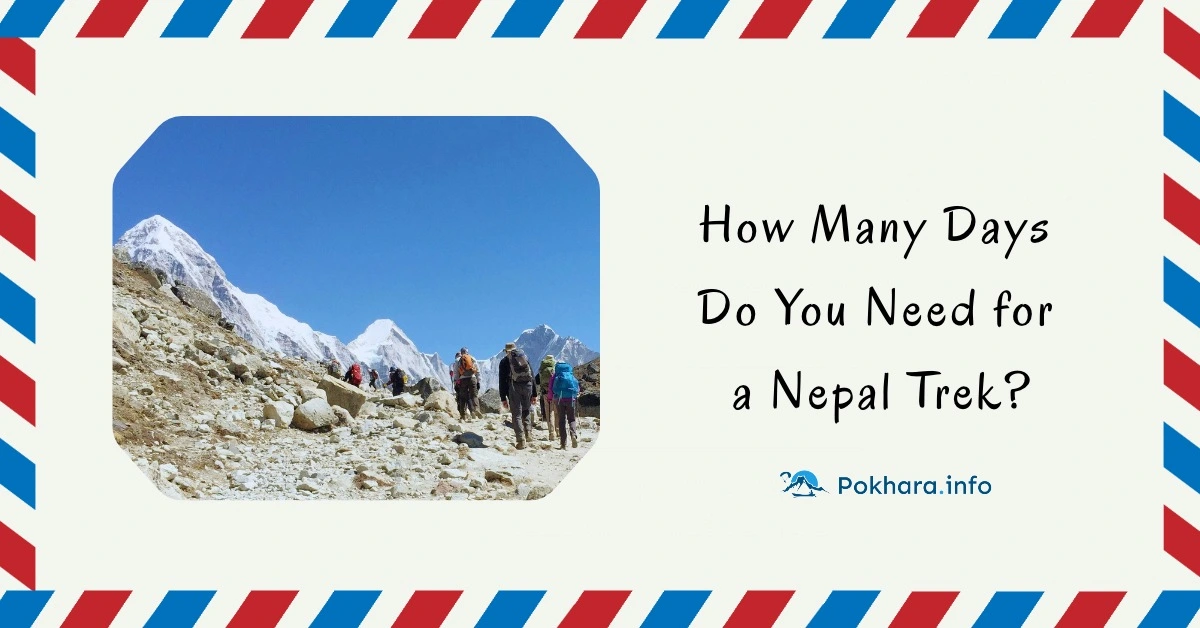
How many days do you need for a trek in Nepal? There is no single answer.
Nepal has everything from short two or three-day Himalayan walks to treks lasting several weeks, and the right duration depends on your available travel time, starting point, altitude, fitness, acclimatization needs and what you want to experience.
The Annapurna region is a good example of this range. Nepal Tourism Board describes it as offering everything from short three-day treks to the roughly three-week Annapurna Circuit. The Everest Base Camp trek, meanwhile, is commonly planned as a roughly two-week journey from Lukla, while Langtang Valley generally takes around 8-12 days.
A shorter trek is not necessarily an easier trek, and adding days does not automatically make a route more difficult. Extra time can allow for acclimatization, shorter walking days, side trips and greater flexibility when weather or transportation changes your plans.
How Many Days Should You Spend Trekking in Nepal?
As a general guide:
Available time | What you can realistically consider | Typical experience |
2-3 days | Short hill and Himalayan-view treks | Villages, forests, viewpoints and mountain panoramas |
4-5 days | Short regional treks | More time in the mountains without committing to a long itinerary |
6-7 days | Week-long treks | Deeper mountain experience and, on suitable routes, higher elevations |
8-10 days | Longer regional treks | More substantial Himalayan routes with additional walking and acclimatization |
11-14 days | Major classic treks | Routes such as Everest Base Camp or selected longer Annapurna/Langtang itineraries |
15-21+ days | Extended Himalayan journeys | Full circuits, remote regions and routes requiring more acclimatization and logistics |
These are planning categories rather than fixed durations. The same trek can take different numbers of days depending on the itinerary, starting point, acclimatization schedule and transport arrangements.
2-3 Days: Best for a Short Himalayan Escape
If you only have a few days available, you do not need to abandon the idea of trekking in Nepal.
Short routes around Pokhara are particularly practical because the Annapurna region is directly connected with the city. Nepal Tourism Board highlights short treks to places such as Sikles and Ghandruk, alongside longer Annapurna itineraries.
A two or three-day trek can provide:
Himalayan mountain views
Village and local-culture experiences
Forest and ridge walking
Sunrise viewpoints
A taste of trekking without committing to a multiweek itinerary
These shorter routes are especially useful for travelers who have Nepal-wide sightseeing plans and want to combine a trek with Kathmandu, Pokhara, Chitwan or other destinations.
However, do not judge a trek purely by its number of days. A short itinerary can still involve steep ascents and long walking days.
4-5 Days: More Time Without a Long Commitment
Four or five days gives you considerably more flexibility than a weekend trek. You can spend several nights in the mountains, move farther from the trailhead and choose a route with a stronger combination of scenery and village experiences.
This duration works particularly well for travelers staying in Pokhara who want a genuine Himalayan trekking experience but do not have enough time for a week-long or two-week route.
Possible choices can include selected itineraries in the Annapurna foothills, depending on the trailhead and current route conditions. A shorter version of a longer trek should not simply be treated as the full trek compressed into fewer days.
The itinerary should be designed around realistic daily walking distances and the actual transport available.
6-7 Days: A Full Week in the Mountains
A week gives you enough time to go beyond a quick viewpoint trek and spend several consecutive nights in the Himalayan landscape.
Seven days can work well for selected Annapurna and other regional routes. It can also allow an itinerary to include a gradual ascent rather than trying to cover too much ground each day.
For travelers beginning in Pokhara, a week can be a particularly useful compromise: long enough to experience several mountain villages and landscapes while leaving time for other parts of a Nepal trip.
At this duration, pay more attention to elevation gain and maximum altitude, not just distance. A seven-day trek reaching 4,000 meters requires a different approach from a seven-day route that remains in the lower hills.
8-10 Days: Longer Treks With More Altitude
Eight to ten days opens up substantially more options. You have enough time for longer regional routes and can build in acclimatization or rest days where the altitude demands it.
The Langtang Valley Trek, for example, is commonly presented by Nepal Tourism Board as an 8-12-day route. This illustrates why a trek should not be assigned a single universal duration: the final itinerary depends on walking pace, acclimatization and the chosen start and finish points.
At this duration, travelers should think about:
Maximum altitude
Number of acclimatization days
Daily elevation gain
Trail difficulty
Distance between overnight villages
Transport time before and after the trek
Weather-related flexibility
An itinerary that appears to fit neatly into eight days on paper may need additional time if transportation is disrupted or conditions change.
11-14 Days: Classic Himalayan Trekking
Two weeks is one of the most useful timeframes for travelers who want to experience a major Himalayan trek without spending most of their Nepal trip on the trail.
Everest Base Camp
The Everest Base Camp trek is commonly described by Nepal Tourism Board as a two-week trek starting and finishing at Lukla. The route includes time around Namche Bazaar for acclimatization before continuing toward the higher Khumbu settlements and Everest Base Camp.
The important point is that the two-week duration is not simply walking time. Acclimatization is an essential part of the itinerary, and rushing through the route changes the nature of the trek.
Annapurna and Other Regions
A two-week timeframe can also accommodate selected Annapurna itineraries, Upper Mustang and other longer routes, depending on the exact trail and transportation.
Nepal Tourism Board's trekking information gives Upper Mustang at around 12-14 days in one of its route summaries, while other routes in the Annapurna region can be considerably shorter or longer.
15-21+ Days: For Full Circuits and Remote Routes
Three weeks or more allows you to consider some of Nepal's most extensive trekking itineraries.
The Annapurna Circuit is a clear example. Nepal Tourism Board describes the complete circuit around the Annapurna massif as requiring approximately three weeks in its regional information.
Longer trips become particularly valuable when a trek includes:
High mountain passes
Several acclimatization stops
Remote valleys
Long approaches to and from the main trail
Side trips
Restricted areas
Limited transportation
Camping or more complex logistical arrangements
Some remote treks can take substantially longer. Nepal Tourism Board's published route information, for example, lists Manaslu Circuit at approximately 16-20 days and Dhaulagiri Circuit at approximately 14-21 days.
The longer the route, the more important it becomes to allow contingency time rather than planning every day with no margin.
Popular Nepal Treks by Duration
The following examples provide a useful starting point when deciding how much time to allocate.
Trek | Approximate duration | Main consideration |
Short Annapurna-area treks | 2-5 days | Good for travelers with limited time |
Mardi Himal | Around 6-8 days | Gradual progression to a high viewpoint/base-camp area |
Langtang Valley | Around 8-12 days | Higher-altitude valley trek with acclimatization considerations |
Everest Base Camp | Around 11-14 days | High altitude and planned acclimatization |
Upper Mustang | Around 12-14 days | Remote trans-Himalayan landscape and special permit requirements |
Manaslu Circuit | Around 16-20 days | Long route with high-altitude pass crossing |
Annapurna Circuit | Around 15-21+ days | Duration varies substantially with transport and itinerary |
These durations are indicative rather than guaranteed. Nepal Tourism Board itself publishes different durations for routes depending on the source and itinerary, while actual trekking time changes with the chosen starting point, transportation, acclimatization and side trips.
Why You Should Not Choose a Trek by Day Count Alone
A common planning mistake is to search for a "7-day trek" or "10-day trek" and compare routes only by duration.
Two seven-day treks can have completely different physical demands.
One may stay below 3,000 meters and involve relatively short daily walks. Another may climb rapidly toward 4,000 meters or higher and require careful acclimatization. Similarly, a ten-day itinerary can be relaxed on one route and demanding on another.
When comparing treks, look at at least five factors:
Maximum Altitude: Altitude becomes increasingly important as the route climbs higher. A trek's highest overnight stop or viewpoint can matter more than its total number of days.
Daily Elevation Gain: Two routes can cover similar distances while producing very different physical demands because one climbs much more steeply.
Walking Hours: Daily walking time gives you a better idea of what each trekking day actually looks like than the total trip length.
Acclimatization: High-altitude itineraries need enough time for the body to adjust. Everest Base Camp, for example, includes time around Namche and later higher settlements rather than simply walking continuously toward Base Camp.
Access and Transportation: Your trekking duration is not necessarily the same as your total travel time. A trek may require a road journey or flight to the trailhead and another transfer after finishing. Nepal Tourism Board notes that many trekking routes involve transportation to remote starting points, and some require domestic flights.
How Many Days Should You Add for Travel?
When planning your Nepal itinerary, separate trekking days from total trip days.
For example, a 7-day trek does not necessarily mean you need exactly seven days between arriving in Nepal and leaving. You may need time for:
Arrival and preparation
Travel from Kathmandu or Pokhara to the trailhead
The trek itself
Return transportation
Weather or transport delays
A buffer before an international flight
This is particularly important for routes involving mountain flights or long road transfers.
If your international flight home is fixed, avoid creating an itinerary where a delayed mountain flight or road journey would immediately cause you to miss your departure.
How Many Days Do You Need for a Nepal Trek From Pokhara?
Pokhara is one of Nepal's most convenient bases for short and medium-length trekking in the Annapurna region.
For a traveler with only a few days, a 2-5 day trek around the Annapurna foothills can fit more easily into a wider Nepal itinerary. With 6-10 days, you can consider longer Annapurna routes and higher destinations, depending on your experience and the itinerary.
The Annapurna region extends from lower elevations around the Pokhara side toward high Himalayan terrain, so increasing the number of days can also mean increasing altitude and difficulty. Nepal Tourism Board identifies Pokhara as the gateway for popular treks toward Jomsom, Annapurna Base Camp, Mustang and Manang, as well as shorter routes such as Sikles and Ghandruk.
Pokhara is therefore an excellent starting point when time is limited, but the route still needs to be selected according to altitude, walking requirements and current trail conditions.
What Is the Minimum Time Needed for a Nepal Trek?
There is no official minimum number of days for "a Nepal trek." A trek can be a short multi-day hike or a journey lasting several weeks.
If you have only 2-3 days, you can still experience the Himalayan foothills and mountain villages. If you have 5-7 days, your options expand considerably. Around 10-14 days, you can consider several of Nepal's classic higher-altitude routes.
The important distinction is that a short trek should be chosen because the route naturally fits the available time, not because a longer high-altitude trek has been unnecessarily compressed.
Should You Take Extra Days for Acclimatization?
For higher-altitude treks, extra days can be more valuable than simply increasing the distance covered.
Acclimatization days allow trekkers to spend additional time at elevation before climbing higher. On the Everest Base Camp route, for example, Nepal Tourism Board specifically recommends spending time around Namche Bazaar and using the surrounding trails for acclimatization.
A good itinerary therefore asks: "How many days does this route need to be done realistically?"
rather than: "How quickly can I complete it?"
This distinction becomes increasingly important as the route climbs above the lower trekking elevations.
How to Choose the Right Trek Based on Your Time
If You Have 2-3 Days
Choose a short trek near Pokhara or another accessible trekking gateway. Prioritize scenery, villages and manageable logistics rather than trying to reach a major high-altitude destination.
If You Have 4-5 Days
Look for a short regional itinerary that gives you several nights in the mountains. This is a good compromise for travelers combining trekking with sightseeing elsewhere in Nepal.
If You Have 6-7 Days
Consider a week-long trek that allows a more gradual itinerary. Annapurna offers particularly broad choices in this range.
If You Have 8-10 Days
You can consider longer Himalayan routes where altitude and acclimatization become more significant. Langtang is one example of a trek commonly planned within or around this timeframe.
If You Have 11-14 Days
This is a strong timeframe for a classic high-altitude experience such as Everest Base Camp, subject to the exact itinerary and transport schedule.
If You Have 15-21+ Days
You can consider full circuits and more remote routes. Annapurna Circuit, Manaslu and other extended Himalayan treks become realistic possibilities, although their requirements vary considerably.
Trekking Duration and Current Permit Requirements
The number of trekking days can also affect planning for permits and guides.
The Nepal Tourism Board currently lists numerous major routes, including Everest Base Camp, Langtang, Manaslu Circuit, Annapurna Circuit, Poon Hill-ABC, Mardi Himal and Upper Mustang, under routes where a licensed guide and agency-issued TIMS card are required. Restricted areas may also require additional trekking permits.
This means that choosing a trek based only on its duration is incomplete. Before booking, check the route's current guide, TIMS, conservation-area, national-park and restricted-area requirements.
Conclusion
There is no single answer to how many days to trek in Nepal. Your ideal duration depends on the route you choose, your available travel time and how much altitude and distance you want to cover.
With 2-3 days, you can experience a short Himalayan trek. 4-7 days provides more options around regions such as Annapurna. 8-14 days opens the door to longer and higher-altitude journeys, including routes such as Langtang and Everest Base Camp. With 15-21 days or more, you can consider full circuits and remote Himalayan routes.
The best itinerary is not the one that fits the most walking into the fewest days. It is the one that gives you enough time for the route's altitude, terrain, acclimatization, transportation and realistic daily walking schedule.
Frequently Asked Questions
How many days are enough for a Nepal trek?
For a first short Himalayan experience, 3-5 days can be enough. A week provides more time in the mountains, while 10-14 days opens up several major trekking routes. Longer circuits may require two to three weeks or more.
Is a 3-day trek in Nepal worth it?
Yes. A three-day trek can provide mountain views, village experiences, forest trails and sunrise viewpoints without requiring a long absence from the rest of your Nepal itinerary. The Annapurna region is particularly well suited to short treks.
Is 7 days enough for a Nepal trek?
Seven days is enough for many short and medium-length routes, particularly in the Annapurna region. It is generally not enough to complete major itineraries such as the standard Everest Base Camp trek without substantially changing the route.
How long is the Everest Base Camp trek?
Nepal Tourism Board describes the Everest Base Camp trek as a roughly two-week trek starting and finishing at Lukla. The itinerary includes acclimatization stops, including time around Namche Bazaar.
How long does the Annapurna Circuit take?
The complete Annapurna Circuit is generally a much longer trek than a one-week itinerary. Nepal Tourism Board describes it as requiring approximately three weeks to go around the Annapurna massif, although modern road access and different itinerary designs can change the actual duration.
Can I do a Nepal trek in only 2 days?
Yes, if you choose a suitable short route. Two days is more appropriate for a short hill or foothill trek than for a high-altitude Himalayan route. The starting location, transportation and walking requirements should be considered when selecting the itinerary.