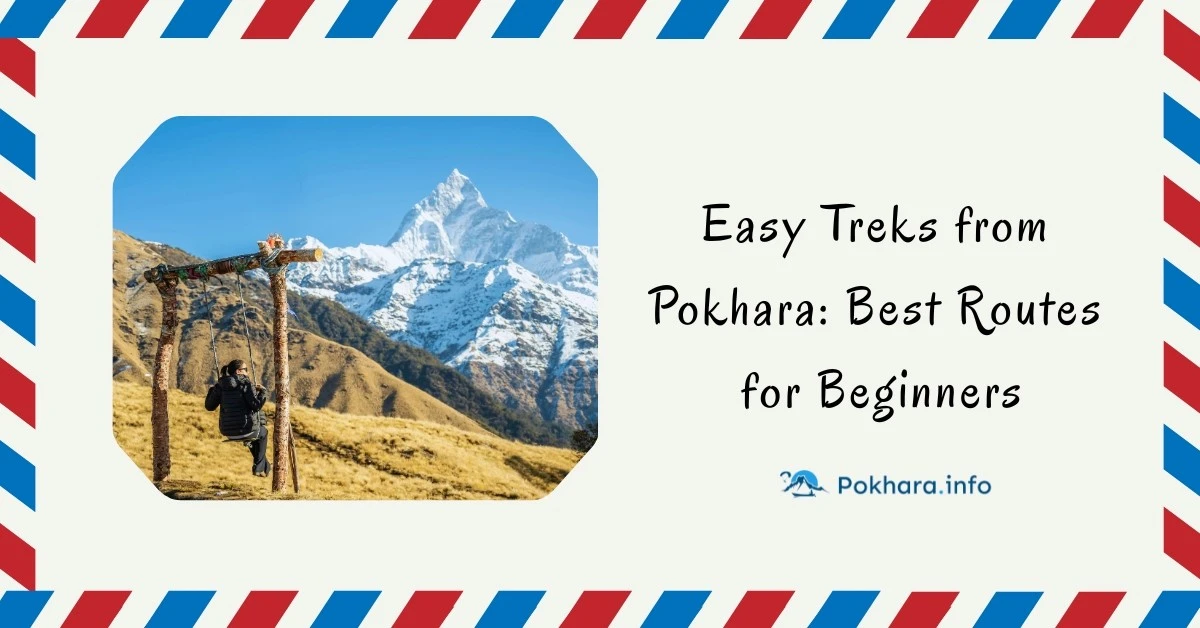
Pokhara is one of the best places in Nepal to begin trekking because the city sits close to the Annapurna region and is surrounded by short Himalayan trails. You do not need to commit to a two-week expedition to experience mountain villages, rhododendron forests and Annapurna views.
For beginners, however, the word "easy" can be misleading. A trek can be short but still involve steep stone steps, long descents or significant altitude gain. The best beginner route therefore depends on more than the number of days.
The most suitable easy treks from Pokhara include Australian Camp-Dhampus, the Royal Trek, Panchase, short Ghandruk itineraries and Ghorepani-Poon Hill. They differ considerably in walking time, altitude, terrain, scenery and physical demands.
What Makes a Trek from Pokhara Easy?
A beginner-friendly trek is not necessarily completely effortless. It generally has a combination of:
Manageable daily walking hours
Moderate elevation gain
No technical climbing
Well-established trails
Villages or lodges along the route
Relatively straightforward transportation from Pokhara
Lower maximum altitude than high Himalayan treks
Flexible itinerary options
The most important factors are walking duration, elevation gain, highest sleeping altitude, trail surface and the amount of uphill and downhill walking.
A two-day trek with steep ascents can feel harder than a four-day route with shorter walking days. Similarly, a route reaching more than 3,000 meters deserves more attention to altitude than a low-elevation village hike.
Nepal Tourism Board identifies numerous short hiking destinations around Pokhara, including Australian Camp, while longer trekking routes extend into the Annapurna region.
Best Easy Treks from Pokhara at a Glance
Trek | Typical Duration | Approx. Highest Point | Best For | Main Challenge |
Australian Camp-Dhampus | 1 to 3 days | Around 2,000 m | First-time trekkers, short trips | Uphill sections and stone steps |
Royal Trek | 3 to 4 days | Around 1,700 m | Beginners seeking a gentle route | Repeated hills rather than altitude |
Panchase | 2 to 4 days | 2,513 m | Nature and village experience | Forest climbs and descents |
Ghandruk | 2 to 4 days | Around 2,000 m | Culture, villages and mountain views | Stone steps and route variation |
Ghorepani-Poon Hill | 3 to 5 days | 3,210 m | Mountain sunrise and classic trekking | Long stair sections and altitude |
These are not equally easy. Australian Camp-Dhampus and the Royal Trek are generally better choices for someone who wants to minimize altitude and long walking days, while Ghorepani-Poon Hill provides a more substantial Himalayan trekking experience but involves more climbing and reaches 3,210 meters.
Australian Camp-Dhampus
Australian Camp and Dhampus are among the most accessible short trekking destinations from Pokhara. The route combines forest trails, Gurung villages, hillside farmland and mountain viewpoints without requiring a long expedition.
It is particularly suitable for travelers who want to experience trekking for the first time but have only a day or two available.
Why Beginners Like It
The main advantage is its accessibility. You can travel from Pokhara toward the trailhead and begin walking without spending an entire day reaching a remote part of Nepal.
The route also provides a good introduction to Himalayan trail conditions: uneven paths, stone steps, forest sections, village settlements and uphill walking.
What to Expect
Australian Camp sits at roughly 2,000 meters, making it substantially lower than high-altitude destinations such as Annapurna Base Camp.
Depending on the itinerary and starting point, the walk can be relatively short, but some sections are still uphill. Beginners should not interpret "short" as completely flat or effortless.
Best For
First-time trekkers
Travelers with limited time
Families and active older travelers
Visitors staying in Pokhara
Anyone wanting mountain scenery without a high-altitude expedition
Nepal Tourism Board specifically lists Australian Camp among the popular hiking destinations around Pokhara.
Royal Trek
The Royal Trek is one of the more gentle options for travelers who want several days of walking without reaching high Himalayan elevations.
The route passes through villages, forests, cultivated hillsides and areas with views toward the Annapurna range. Nepal Tourism Board places the Royal Trek at around 1,720 meters and describes it as suitable for people of different age groups.
Why It Is Beginner-Friendly
Its main advantage is relatively modest altitude.
Rather than making altitude the primary challenge, the route's physical demand comes from walking through Nepal's rolling mid-hill terrain. There are still ascents and descents, but the trek does not require crossing a high mountain pass.
Best For
The Royal Trek is particularly appropriate for:
First-time trekkers
Travelers concerned about altitude
Families seeking a multi-day walking experience
Visitors interested in villages and local landscapes
People who want a slower introduction to trekking
It is a good option if your goal is to learn what trekking in Nepal feels like without immediately committing to a high-altitude route.
Panchase Trek
Panchase offers a different type of beginner trekking experience. Instead of being primarily about reaching a famous high-altitude viewpoint, the route combines forests, villages, agricultural landscapes and panoramic views.
Panchase overlooks the Pokhara area and sits at approximately 2,513 meters. Nepal Tourism Board describes the area as a hill at the meeting point of five hills, with viewpoints and cultural attractions.
Why Choose Panchase?
Panchase is particularly appealing if you want:
Forest walking
Rural villages
A quieter route
Mountain views
A short multi-day itinerary
A combination of nature and culture
The route can normally be adapted to different itineraries, with Nepal Tourism Board material describing Panchase trekking options of roughly 2 to 4 days.
Is Panchase Easy?
It can be beginner-friendly, but it should not be treated as a flat walking route.
Forest trails include uphill and downhill sections, and the maximum elevation is higher than Australian Camp or the Royal Trek. Someone who is new to trekking should prepare for several hours of walking and repeated elevation changes.
Ghandruk Trek
Ghandruk is one of the most popular village destinations near Pokhara and is an excellent choice for beginners who want culture as much as scenery.
The village is a traditional Gurung settlement with mountain views and tourism infrastructure. Nepal Tourism Board notes that Ghandruk has hotels and lodges and is approximately 54.8 km from Pokhara by road, with an estimated driving time of around 1 hour 35 minutes under its stated route conditions.
What Makes Ghandruk Special?
Ghandruk offers more than a mountain viewpoint. The village itself is part of the experience.
You can explore:
Traditional Gurung architecture
Local villages and farms
Mountain viewpoints
The Gurung Museum
Stone-paved village paths
Annapurna and Machhapuchhre views
The area is also connected to other trekking routes, including trails toward Landruk and Tadapani.
Is Ghandruk Easy for Beginners?
A short Ghandruk itinerary can be beginner-friendly, but the difficulty depends heavily on where you start and finish.
A road-access itinerary with shorter walking sections is considerably different from approaching Ghandruk through a longer trail from lower elevations.
Expect:
Stone steps
Uphill village paths
Downhill sections
Uneven terrain
Several hours of walking depending on the itinerary
For beginners who want culture, village life and mountain scenery, Ghandruk is one of the strongest choices.
Ghorepani-Poon Hill Trek
Ghorepani-Poon Hill is probably the most substantial option on this list.
It is frequently recommended to beginners because it provides a relatively short introduction to classic Himalayan trekking while offering a famous sunrise viewpoint.
Poon Hill stands at approximately 3,210 meters, and Nepal Tourism Board describes the Ghorepani Poon Hill trek as a popular short trek suitable for beginners and families.
Why Is It Popular?
The attraction is the combination of:
Himalayan sunrise
Annapurna and Dhaulagiri mountain views
Rhododendron forests
Gurung and Magar villages
Tea houses and lodges
A relatively short overall itinerary
Is Poon Hill Actually Easy?
It is better described as beginner-friendly rather than physically easy.
The altitude is higher than the other routes in this comparison, and sections of the trail contain substantial stone stairways. The climb toward Poon Hill can feel demanding, particularly for people who are not accustomed to sustained uphill walking.
The reward is a more complete Himalayan trekking experience.
Who Should Choose Poon Hill?
Choose it if you want:
A first proper Nepal trek
A famous Himalayan viewpoint
Sunrise over the mountains
Several days of trekking
Tea-house accommodation
A route that is challenging without being an extreme high-altitude expedition
Nepal Tourism Board also recommends short Poon Hill and Dhampus treks as options for children depending on age and ability, while advising families to consider altitude carefully.
Which Easy Trek from Pokhara Should You Choose?
The best route depends on what you want from your first trek.
If your priority is... | Consider |
The shortest introduction to trekking | Australian Camp-Dhampus |
Lower altitude | Royal Trek |
Forests and quieter trails | Panchase |
Gurung culture and village life | Ghandruk |
Famous mountain sunrise | Ghorepani-Poon Hill |
A more complete first trekking experience | Ghorepani-Poon Hill |
Limited vacation time | Australian Camp-Dhampus |
A multi-day but relatively gentle trek | Royal Trek |
How Difficult Are These Treks Really?
Difficulty should be judged using several factors rather than a simple "easy" label.
Walking Hours
A beginner should be comfortable walking for several consecutive hours, often on uneven terrain. Even a short trek can become tiring because trekking involves continuous movement rather than a single walk on a level road.
Elevation Gain
The amount of climbing matters as much as the final elevation. A route may have a relatively low highest point but still involve repeated uphill sections.
Descending
Beginners sometimes focus entirely on the climb. Descending can be equally demanding, particularly on stone steps. It can place significant stress on the knees and legs, so walking poles can be useful.
Trail Surface
Expect a mixture of:
Stone steps
Dirt trails
Forest paths
Village roads
Rocky sections
Uneven surfaces
Conditions can change after rain.
Weather
Rain can make stone and dirt trails slippery, while winter conditions can bring cold mornings and potentially snow at higher elevations. Weather should therefore be considered when deciding which route is appropriate, not just the advertised number of trekking days.
How Fit Do You Need to Be?
You do not need to be an experienced mountaineer for these routes. However, basic preparation makes the trek considerably more enjoyable.
Before leaving for a trek, it is useful to build endurance through:
Regular walking
Hiking on hills
Stair climbing
Long weekend walks
Basic leg-strength exercises
Walking with the footwear and daypack you intend to use
If you can comfortably walk for several hours and handle regular uphill and downhill sections, you are in a much better position than someone whose normal activity is entirely sedentary.
You should also avoid making the first trekking day unnecessarily ambitious.
What About Altitude?
Altitude is one of the most important differences between these routes.
Australian Camp, Dhampus and the Royal Trek remain at relatively modest elevations compared with Nepal's high-altitude trekking routes. Panchase rises to around 2,513 meters, while Poon Hill reaches approximately 3,210 meters.
Nepal Tourism Board advises trekkers to pay attention to altitude above 2,500 meters and to ascend gradually. Symptoms of altitude sickness can include headache, nausea, fatigue, dizziness and loss of appetite.
This does not mean that every beginner will experience altitude problems. It means that Poon Hill requires more altitude awareness than a low-elevation short hike around Pokhara.
If you feel unwell at altitude, do not simply assume it is normal tiredness. Avoid ascending while symptoms are worsening and follow appropriate mountain-safety guidance.
Do Beginners Need a Guide?
The answer depends on the exact route.
Nepal's current trekking regulations require a licensed trekking guide and TIMS card on a defined list of trekking routes. The Nepal Tourism Board's current list includes routes such as Poon Hill-ABC, Mardi Himal, Annapurna Circuit, Khopra and Sikleh Tara Hill in the Annapurna region.
However, not every short hike around Pokhara appears on that same list.
This distinction matters because "a short hike near Pokhara" and "a regulated trekking route" are not necessarily the same thing.
Before starting your trek, confirm the current requirements for your exact itinerary rather than assuming that a route is exempt because it is short or beginner-friendly.
For routes where TIMS and a licensed guide are required, Nepal Tourism Board currently states that the arrangements are made through a government-registered trekking agency. The current TIMS charge listed by NTB is NPR 1,000 for SAARC-country applicants and NPR 2,000 for other applicants.
Do You Need a Permit for Treks from Pokhara?
Some routes enter protected areas, where an entry fee applies.
For example, the Annapurna Conservation Area currently lists an entry fee of NPR 3,000 for foreign visitors and NPR 1,000 for SAARC nationals, according to Nepal Tourism Board's current protected-area fee table.
This is separate from TIMS.
A trek may therefore involve more than one requirement:
TIMS, if applicable to the route
Protected-area entry fee, if the route enters a conservation area or national park
Special trekking permit, if the route enters a restricted area
Licensed guide, where current rules require one
Do not treat these as interchangeable.
Restricted-area trekking is subject to additional rules and permits issued through the Department of Immigration.
Where Do You Stay on These Treks?
Accommodation depends on the route and itinerary.
The popular routes around Pokhara generally have access to:
Guesthouses
Tea houses
Lodges
Hotels in larger villages
Homestays on some community-based routes
Ghandruk, for example, has hotels and lodges available for trekkers.
Accommodation standards are not the same as in Pokhara.
A typical trekking lodge may provide a simple private or shared room, basic bedding and communal dining. Hot showers, electricity, Wi-Fi and charging availability can vary by location and season.
It is therefore sensible to carry a power bank and some cash rather than relying entirely on card payments or continuous internet access.
What Should You Pack for an Easy Trek from Pokhara?
You do not need a mountaineering expedition kit for these routes, but you should have appropriate trekking equipment.
Essential Clothing
Comfortable trekking trousers
Moisture-wicking shirts
Warm mid-layer
Lightweight waterproof jacket
Warm layer for mornings and evenings
Trekking socks
Comfortable broken-in hiking shoes
Hat or cap
Gloves for colder seasons
Useful Equipment
Daypack
Reusable water bottle
Water purification method
Sunglasses
Sunscreen
Headlamp
Power bank
Trekking poles
Small first-aid kit
Personal medications
Toilet paper and basic hygiene supplies
Cash in Nepalese rupees
For Higher or Colder Routes
For Poon Hill and winter trekking, add warmer clothing and be prepared for substantially colder conditions than in Pokhara. The Nepal Tourism Board also recommends carrying items such as a torch, rain protection and a first-aid kit while trekking.
What Is the Best Time for Easy Treks from Pokhara?
The best time depends on the route and your priorities, but spring and autumn are generally the most reliable trekking periods. Nepal Tourism Board identifies September to November and February to May as favorable trekking periods, with weather conditions generally more suitable for walking.
Spring: March to May
Spring is particularly attractive for lower and mid-hill routes because:
Rhododendrons bloom
Temperatures become warmer
Mountain visibility can be good
Forest trails become particularly scenic
Autumn: September to November
Autumn is one of the strongest choices for first-time trekkers because:
The monsoon has generally ended
Trails are usually drier
Mountain visibility is often good
Temperatures are comfortable for walking
Winter: December to February
Lower routes around Pokhara can still be suitable in winter. However, mornings and evenings can be cold, and higher routes such as Poon Hill can experience much colder conditions and possible snow.
Monsoon: June to August
Monsoon is less predictable for trekking around Pokhara.
Expect:
Rain
Wet and slippery trails
Mud
Reduced mountain visibility
Leeches in some lower-elevation areas
Possible transport disruption
This does not make every trek impossible, but beginners seeking the easiest experience will generally find the dry seasons more comfortable.
How to Get from Pokhara to the Trek Starting Point
One of the biggest advantages of trekking around Pokhara is the relatively short approach to many trailheads.
Depending on the route, you may use:
Private car
Taxi
Local bus
Tourist vehicle
Shared transport
A combination of road travel and walking
Ghandruk, for example, is directly accessible by road from Pokhara, while other routes begin from places such as Phedi, Kande, Nayapul or other settlements around the Annapurna foothills.
The exact transport arrangement should be confirmed before departure because road conditions, vehicle availability and seasonal conditions can affect travel time.
Can You Do These Treks Without Previous Trekking Experience?
Yes. That is precisely why these routes are useful for first-time trekkers.
You should still choose according to your actual fitness rather than choosing a trek simply because a website calls it "easy."
A sensible progression for someone completely new to trekking could be:
Short Pokhara hike -> Australian Camp/Dhampus -> Royal Trek or Ghandruk -> Panchase -> Poon Hill
This is not a mandatory progression. Someone who regularly hikes or exercises may comfortably begin with Poon Hill.
The important point is to match the route to your walking ability, available time and tolerance for altitude.
Easy Trek vs Day Hike Around Pokhara
Not every mountain experience around Pokhara needs to be a multi-day trek. Pokhara itself has numerous short hiking destinations, including Sarangkot, Kaskikot, Naudanda, Kahundanda and Australian Camp.
A day hike may be the better choice if:
You have only one free day
You do not want to carry trekking equipment
You prefer sleeping in Pokhara
You are unsure about your fitness
You want to test whether you enjoy hiking
A multi-day trek is better if you want to experience village accommodation, multiple days on the trail and a stronger sense of being in the mountains.
How Much Does an Easy Trek from Pokhara Cost?
There is no single price because the cost depends on the route, duration, group size and services included.
Your budget may include:
Transportation from Pokhara
Guide
Porter
Accommodation
Food and drinks
TIMS, where applicable
Conservation-area or national-park entry fees
Equipment rental or purchase
Travel insurance
Personal expenses
Shorter routes can be relatively inexpensive when organized independently where regulations permit, while a guided trek with private transportation and upgraded accommodation will cost more.
For current permit and TIMS charges, always check the latest official requirements rather than relying on an old trekking price list. Nepal Tourism Board currently lists TIMS at NPR 1,000 for SAARC applicants and NPR 2,000 for other applicants on applicable routes.
What Should Beginners Know Before Leaving Pokhara?
A few practical preparations can make a major difference.
Check the Weather: Do not rely only on a generic seasonal forecast. Mountain weather can change quickly.
Break In Your Shoes: New hiking shoes can cause blisters. Wear them before the trek.
Carry Enough Cash: Small villages may have limited payment options.
Start Walking Early: Morning departures give you more daylight and reduce the pressure of reaching your destination late.
Keep Your Backpack Light: For a short trek, unnecessary weight quickly becomes noticeable.
Do Not Underestimate Downhill Walking: Your legs may feel fine during the climb but tired during a long descent.
Keep Your Itinerary Flexible: Road conditions and weather can change transportation times and walking plans.
Which Is the Easiest Trek from Pokhara?
If by "easiest" you mean the shortest and least demanding introduction to Himalayan trekking, Australian Camp-Dhampus is one of the strongest choices.
If you want lower altitude over several days, consider the Royal Trek.
If you want culture and a Himalayan village experience, Ghandruk is particularly attractive.
If you want forest trails and a quieter route, Panchase is worth considering.
If you want the classic short Nepal trekking experience with a famous mountain sunrise, choose Ghorepani-Poon Hill, while recognizing that it is more physically demanding than the lower-elevation options.
Easy Treks from Pokhara for Different Types of Travelers
For Complete Beginners: Australian Camp-Dhampus, it provides a manageable introduction without requiring a long expedition.
For Families: Royal Trek or a short Dhampus/Australian Camp itinerary. The best choice depends on the age and fitness of the travelers. Children should not automatically be treated as equivalent to adults when planning walking distances and altitude.
For Mountain Views: Ghorepani-Poon Hill: The higher viewpoint provides one of the most recognizable sunrise experiences in the Annapurna region.
For Culture: Ghandruk: Its Gurung heritage and village setting make the destination as important as the landscape.
For Nature and Forests: Panchase. The route combines forests, rural landscapes and mountain views.
For a Short First Experience: Australian Camp-Dhampus. It is particularly convenient for travelers staying in Pokhara with limited time.
Final Recommendation
For a first trekking experience from Pokhara, there is no single route that is best for everyone.
Choose Australian Camp-Dhampus if time and physical demands are your biggest concerns. Choose the Royal Trek if you want a gentler multi-day introduction. Choose Panchase for forests and quieter trails, Ghandruk for village culture, and Ghorepani-Poon Hill if your priority is a classic Himalayan trekking experience and mountain sunrise.
Whichever route you choose, check the current guide, TIMS and protected-area requirements for your exact itinerary before leaving Pokhara. Trekking conditions and regulations can change, and the Nepal Tourism Board remains the appropriate starting point for verifying current requirements.
Frequently Asked Questions
What is the easiest trek from Pokhara?
Australian Camp-Dhampus is one of the easiest introductions to trekking around Pokhara. The Royal Trek is another good choice for beginners who want several days of walking at relatively modest elevation.
Which trek from Pokhara is best for first-time trekkers?
It depends on your goals. Australian Camp-Dhampus is suitable for a short introduction, while Poon Hill is a better option if you want a more complete Himalayan trekking experience.
Is Poon Hill suitable for beginners?
Yes. Nepal Tourism Board describes Ghorepani Poon Hill as suitable for beginners and families, but the trek should not be considered effortless. Poon Hill reaches about 3,210 meters and the route includes substantial uphill and stair sections.
Do I need a guide for an easy trek from Pokhara?
Not necessarily for every short hike, but current Nepal regulations require a licensed guide and TIMS on specified trekking routes. Some Annapurna routes, including Poon Hill-ABC and Mardi Himal, are on the current NTB list. Check the exact route before departure.
What is the best month for an easy trek from Pokhara?
Spring and autumn are generally the best periods. September to November and February to May are identified by Nepal Tourism Board as favorable trekking periods.
Can I do an easy trek from Pokhara without being very fit?
You should have enough fitness to walk for several hours, climb hills and manage uneven terrain. Routes vary significantly, so beginners should select the trek based on walking time and elevation rather than the word "easy" alone.